Can You Replace Just One Glass Panel in a Shower Enclosure?
By Abdullah Ghabayen, Glass and Shower Doors · 25 years of glass fabrication and installation across Chicago and the suburbs · Updated October 26, 2026
Quick Answer: Yes, you can often replace just one glass panel in a shower enclosure without replacing the entire shower door system. If the remaining glass, hinges, frame, tracks, and wall mounting are in good condition, a glass professional may be able to measure the damaged panel and fabricate a matching replacement. However, replacement becomes more complicated when the original hardware is discontinued, the frame is damaged, or the replacement glass cannot be made compatible with the existing enclosure.
A broken shower glass panel doesn’t automatically mean you need to spend money on an entirely new shower enclosure.
Many homeowners assume that once one piece of glass cracks or shatters, every panel must be replaced. In reality, shower enclosures are often constructed using multiple individual glass panels, and some can be replaced separately.
But there is an important difference between replacing a single glass panel and simply purchasing a piece of glass that looks similar.
The new panel must fit the opening, match the existing glass specifications, work with the original hardware, and meet applicable safety requirements.
Whether you have a frameless shower door, a sliding enclosure, or a fixed glass panel beside a hinged door, understanding these requirements can help you avoid unnecessary expenses.
This guide explains when individual glass replacement is possible, what makes it difficult, how professionals measure replacement panels, and when replacing the full enclosure is the better decision.
Can One Shower Glass Panel Be Replaced Without Replacing Everything?
In many cases, yes.
Shower enclosures are commonly assembled from separate glass components.
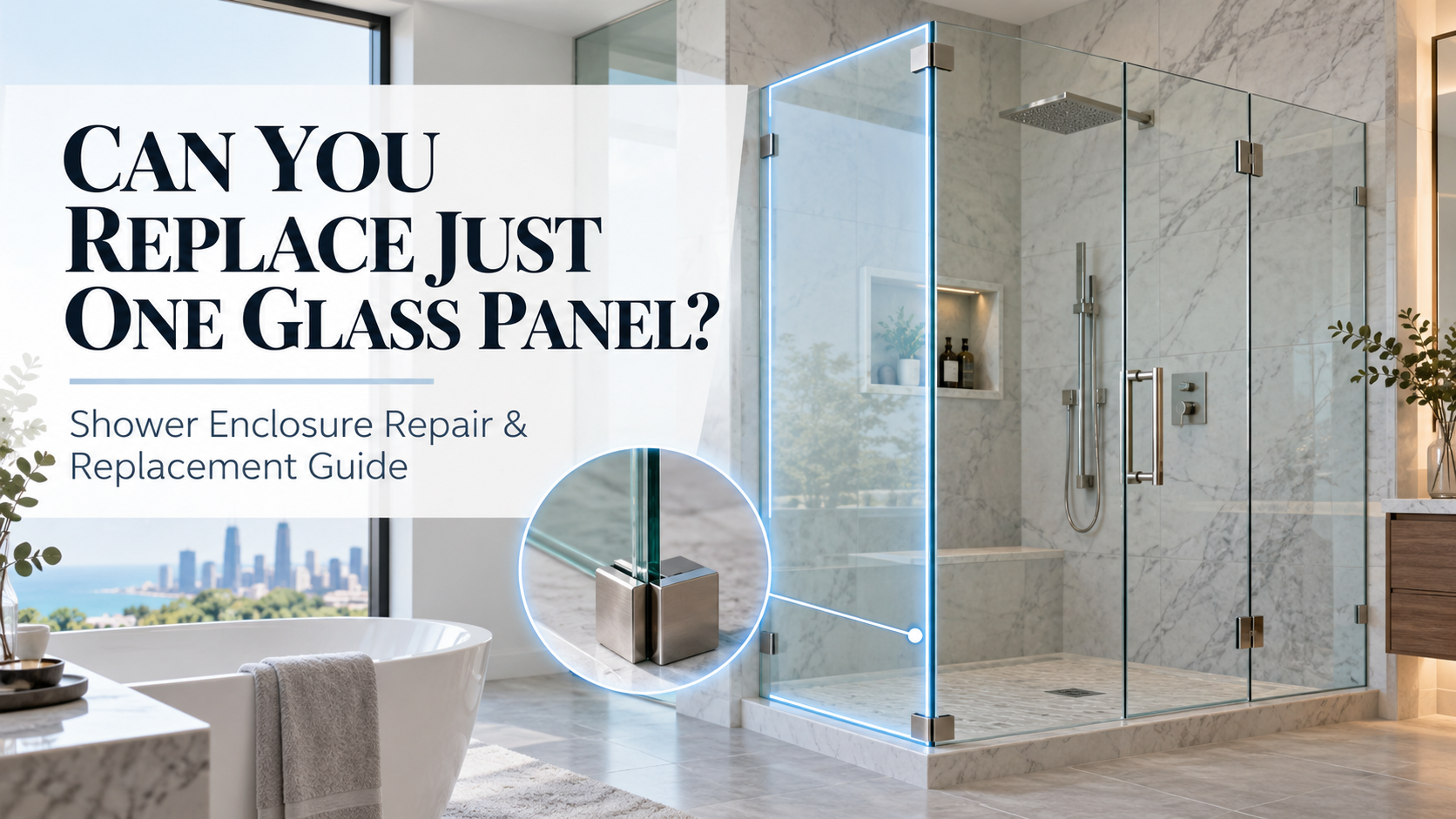
For example, a frameless shower enclosure may have one hinged door and one stationary panel. A larger corner shower may have three or more individual sections.
If one panel breaks while the others remain undamaged, it may be possible to replace only the affected component.
The most important question is whether the remaining enclosure can safely accommodate the new glass.
When Single-Panel Replacement Usually Makes Sense
Replacing one panel may be practical when:
- Only one section of glass is damaged
- The remaining glass is in good condition
- Hinges and mounting brackets are structurally sound
- Existing tracks and rollers still function correctly
- Compatible hardware remains available
- The replacement panel can be accurately measured
- The enclosure is properly secured to the surrounding walls
- The new panel can meet the applicable safety-glazing requirements
When these conditions are met, replacing one panel can preserve much of the original installation.
When Replacing One Panel May Not Work
A complete enclosure replacement may be necessary when:
- Multiple panels are damaged
- The supporting frame is severely corroded
- Existing hardware cannot support a replacement panel
- The original system uses discontinued components
- The wall mounting is unstable
- The enclosure was incorrectly installed
- The new glass cannot be safely fitted to the existing system
An experienced glass installer should evaluate these conditions before recommending replacement.
The goal is to determine whether the existing enclosure remains a safe and practical foundation for new glass.
1. Which Shower Glass Panels Can Be Replaced Individually?
The answer depends on the shower enclosure’s construction.
Some systems are specifically designed with individual serviceable components.
Others rely on proprietary hardware or integrated frame assemblies that make replacement more complicated.
Frameless Hinged Shower Doors
Frameless shower doors are often good candidates for individual glass replacement when the hinges and surrounding installation remain sound.
The damaged door can potentially be replaced with a new tempered glass panel fabricated to the same required specifications.
However, the fabricator must confirm:
- Glass thickness
- Overall width and height
- Hinge-hole locations
- Handle-hole locations
- Edge finish
- Corner details
- Hinge compatibility
- Clearance requirements
These details are especially important because frameless systems rely on precise hardware positioning.
A replacement door that differs slightly from the original may not align correctly.
Fixed Glass Shower Panels
A stationary glass panel can also sometimes be replaced separately.
Fixed panels may be supported by clamps, wall channels, brackets, or other approved mounting systems.
If the mounting system is undamaged and compatible replacement glass can be fabricated, the old panel may be removed and replaced.
However, replacing a fixed panel can be more complicated when it supports an adjacent hinged door.
In that situation, the panel may carry additional loads through glass-to-glass hinges.
The technician must evaluate the complete assembly, not just the damaged glass.
Sliding Shower Door Panels
Sliding shower enclosures frequently contain two glass panels.
One or both panels may move, depending on the system.
If one panel breaks, replacement may be possible while retaining the original tracks and hardware.
The challenge is matching the new panel to the roller and guide system.
The fabricator may need to reproduce specific holes, cutouts, edge details, and clearances.
A replacement panel cannot simply be chosen by width and height alone.
Corner and Neo-Angle Enclosures
Corner enclosures sometimes use glass panels that meet at unusual angles.
A damaged panel may need to be custom fabricated using accurate measurements of the existing opening.
This type of work can be more complex because the replacement must align with the remaining panels at the intended angles.
If the supporting hardware is still available and the rest of the enclosure is sound, single-panel replacement may remain feasible.
2. What Happens When Tempered Shower Glass Breaks?
Most modern shower enclosures use tempered safety glass.
Tempered glass is manufactured through a controlled heating and cooling process that creates internal stresses.
These stresses give the glass its characteristic strength and breakage behavior.
When tempered glass fails, it typically breaks into many relatively small fragments rather than large, sharp shards.
However, those fragments can still cause cuts or other injuries.
Why Doesn’t Tempered Glass Usually Develop One Long Crack?
Ordinary annealed glass may develop a visible crack that remains in place.
Fully tempered glass behaves differently because of the stresses introduced during manufacturing.
A significant crack or damage can cause the entire panel to fracture.
This is why homeowners sometimes describe a shower door as having shattered suddenly.
The event may appear unexpected, particularly when nobody was using the shower at the time.
What Causes Tempered Shower Glass to Break?
Possible contributing factors include:
- Impact from a hard object
- Damage to a glass edge or corner
- Contact with an improperly positioned metal component
- Excessive stress caused by unsuitable installation conditions
- Manufacturing defects or inclusions
- Movement in hardware that creates unintended glass contact
In some cases, breakage occurs without a clearly identifiable external impact.
One recognized mechanism involves certain nickel sulfide inclusions within tempered glass.
However, the presence of shattered glass alone does not establish what caused the failure.
An inspection may identify contributing conditions, but determining the exact cause is not always possible.
What Should You Do After a Shower Glass Panel Shatters?
First, keep children, pets, and anyone without protective footwear away from the bathroom.
Avoid using the shower.
Do not attempt to remove remaining glass from hinges or clamps.
Some fragments may still be held by hardware, and disturbing those components can cause additional pieces to fall.
If cleanup is necessary, use appropriate protective equipment and avoid handling unstable mounted fragments.
For a large broken panel or glass remaining inside the mounting system, professional removal is the safer option.
Do not operate an enclosure with a missing structural panel or unstable hardware.
3. Can a Cracked Shower Glass Panel Be Repaired Instead of Replaced?
A cracked shower glass panel generally requires replacement rather than conventional glass repair.
Unlike certain automotive glass repairs, shower safety glass is not normally restored by filling a crack with resin.
Even if a crack appears small, its presence may indicate that the panel is no longer suitable for continued use.
What About Small Chips?
Small surface marks and chips are not all equivalent.
A superficial mark that does not affect the glass structure may be different from damage at an edge, corner, or hardware hole.
However, edge damage is particularly concerning because it can create stress concentrations.
A glass professional should evaluate questionable damage rather than assume it is harmless.
Can You Glue Cracked Shower Glass Together?
No household adhesive should be relied on to restore the structural performance of cracked tempered shower glass.
Products marketed for general glass repair do not necessarily restore the required strength or safety characteristics of a shower door panel.
For a cracked or structurally damaged panel, replacement is the appropriate solution.
Can You Reuse the Existing Handle and Hinges?
Potentially.
If the hardware is undamaged, compatible with the replacement glass, and approved for continued use, some components may be reusable.
However, hardware should be inspected before reinstallation.
A glass breakage event may damage hinges, clamps, gaskets, fasteners, or adjacent components.
The technician should not automatically reuse hardware simply because it remains attached.
4. How Do Professionals Match Replacement Shower Glass?
Matching the replacement glass is one of the most important parts of the process.
Two pieces of shower glass can look nearly identical while having different technical specifications.
A professionally fabricated replacement must be suitable for the existing system.
Glass Thickness
Common frameless shower glass thicknesses include:
- 3/8 inch
- 1/2 inch
Other enclosure designs may use different thicknesses according to their specifications.
The replacement must be compatible with the hardware and system design.
For example, hardware intended for a 3/8-inch panel should not automatically be assumed suitable for 1/2-inch glass.
Thickness affects weight, gasket fit, clamp dimensions, and hardware loads.
Glass Color and Clarity
Not all clear glass looks identical.
Standard clear glass often has a subtle greenish tint associated with its iron content.
Low-iron glass has a more neutral appearance.
If you replace one panel with low-iron glass while keeping neighboring standard clear panels, the color difference may be noticeable.
The replacement should be selected with the existing enclosure in mind.
For a detailed comparison of glass appearances, see our clear, frosted, and low-iron shower glass guide.
Glass Pattern
Some enclosures use frosted, textured, rain, or patterned glass.
Matching these products may be difficult if the original design is discontinued.
Even when a similar pattern is available, slight differences may be noticeable.
The homeowner may need to decide whether an approximate match is acceptable.
Edge Finish
Glass edges may be polished, shaped, or otherwise finished according to the original design.
The replacement must have the necessary edge treatment and be suitable for the intended mounting arrangement.
Hardware Cutouts
Frameless shower doors often require precise holes or notches for hinges and handles.
These details must be fabricated before the glass is tempered.
If the holes are placed incorrectly, the new panel may be unusable.
Replacement Matching Checklist
| Feature | Why it matters |
|---|---|
| Panel width and height | Proper fit and operating clearance |
| Glass thickness | Hardware and weight compatibility |
| Glass type | Appearance and specifications |
| Edge finish | Safety and visual consistency |
| Hinge holes | Correct mounting alignment |
| Handle holes | Compatibility with existing handle |
| Notches and cutouts | Fit around hardware and surrounding features |
| Safety-glazing compliance | Suitable performance for shower use |
5. Why Can’t a Glass Company Simply Cut a Replacement From an Existing Tempered Panel?
Tempered glass must be fabricated in the correct shape before tempering.
The usual manufacturing sequence includes:
- Cutting the glass to the required dimensions
- Creating approved holes and notches
- Finishing the glass edges
- Tempering the completed panel
- Inspecting the finished product
Once glass has been fully tempered, it generally cannot be cut, drilled, or reshaped.
Attempting to do so can cause the panel to shatter.
Why Accurate Measurements Matter
Suppose an existing shower door uses two wall hinges and a vertical handle.
The replacement panel must align with the original hinge positions and surrounding glass.
If the hinge holes are even slightly incorrect, the hardware may not fit or operate properly.
The glass company may need to take measurements directly from the existing opening, assess the original design, or create a detailed fabrication template.
For unusual enclosures, measuring only the broken fragments is not a reliable substitute for checking the installed geometry.
Can a Replacement Panel Be Ordered Online?
Possibly, but ordering a custom shower panel from rough measurements carries risks.
A panel needs to meet the system’s actual requirements.
Incorrect thickness, hole locations, edge details, or dimensions can make a panel unsuitable even if it looks correct in a product photograph.
Professional measurement and fabrication are particularly valuable when trying to reuse an existing enclosure.
6. Can You Replace a Shower Glass Panel if You Don’t Know the Manufacturer?
Often, yes.
Many homeowners purchase a home without knowing who installed the shower enclosure.
The original manufacturer may no longer be operating, or the homeowner may not have any paperwork.
This doesn’t automatically prevent replacement.
How a Glass Technician Identifies the Existing System
The technician may examine:
- Hinge design
- Roller configuration
- Glass thickness
- Hardware dimensions
- Mounting-hole locations
- Available manufacturer markings
- Frame profile
- Seal and gasket style
- Overall enclosure construction
This information can help determine whether compatible hardware and glass can be sourced or fabricated.
What if the Hardware Is Discontinued?
This is one of the most important limitations.
Even when the glass can be fabricated, replacement may not be practical if the original system depends on unavailable proprietary components.
For example, an older sliding shower door might require rollers with an unusual mounting pattern.
If those rollers are damaged and compatible replacements cannot be obtained, installing a new glass panel alone may not solve the problem.
Can Different Hardware Be Substituted?
Sometimes, but compatibility must be established.
A replacement hinge or roller must meet the necessary dimensions, load requirements, and mounting specifications.
Simply drilling different holes in the original tempered glass is not an option.
A different hardware system may require a new glass design or a complete enclosure replacement.
7. Can You Replace Only the Stationary Panel Next to a Shower Door?
Yes, in certain enclosures.
A stationary panel is often called a fixed or inline panel.
It may sit beside a hinged door, at the end of a shower enclosure, or along one side of a corner shower.
When Fixed Panel Replacement Is Straightforward
Replacement may be relatively practical when the panel is independently supported and the mounting components are in good condition.
The installer can evaluate the channels, clamps, supporting wall, and existing measurements.
When Fixed Panel Replacement Is More Complicated
Some fixed panels serve as attachment points for a hinged door.
For example, a shower door may hang from glass-to-glass hinges connected to a stationary panel.
In this situation, the fixed panel has an important structural role.
The replacement must be appropriate for those loads and hardware requirements.
The technician must also safely support or remove the attached door during the replacement process.
Can the Original Shower Door Remain?
Potentially.
If the existing door remains undamaged and compatible with the replacement fixed panel, it may be retained.
However, the installer may need to temporarily remove the door to complete the work safely.
This is a project-specific determination rather than a guarantee.
8. Is Replacing One Sliding Shower Door Panel Different?
Sliding systems introduce additional compatibility requirements.
A hinged door transfers its weight through hinges, while a sliding panel may depend on rollers, rails, guides, and other components.
What Must Be Checked?
The installer should evaluate:
- Roller condition
- Track alignment
- Panel weight
- Guide compatibility
- Mounting-hole positions
- Required panel overlap
- Anti-derailment hardware
- Stops and operating clearance
A replacement panel must be appropriate for the existing movement system.
Can You Keep the Existing Track?
Possibly.
If the track is undamaged, properly anchored, and compatible with the replacement, it may be retained.
However, an old track that is corroded, bent, or excessively worn may undermine the repair.
What if the Original Panel Used a Special Roller?
Some shower systems use proprietary rollers and mounting details.
Matching these components can be the deciding factor.
If the required parts are unavailable, a full sliding enclosure replacement may offer a more reliable result.
Learn about the different configurations available through our sliding shower door services in Chicago.
9. When Is It Better to Replace the Entire Shower Enclosure?
Although single-panel replacement is often possible, it isn’t always the best investment.
A professional evaluation should consider the overall condition of the enclosure.
Situation 1: The Frame Is Severely Corroded
Some older framed shower doors develop significant corrosion around the tracks and mounting points.
If the supporting components are deteriorated, installing new glass may not address the underlying problem.
A complete replacement may provide a more dependable result.
Situation 2: Multiple Panels Are Damaged
If several panels are cracked, etched, or damaged, replacing each one individually may not be economical.
The cost of multiple custom panels can approach that of a new enclosure.
Situation 3: The Hardware Is No Longer Available
Discontinued hardware can limit replacement options.
Even if new glass can be made, an incompatible hinge or roller system may prevent safe installation.
Situation 4: The Enclosure Was Installed Incorrectly
An existing shower door that has never operated correctly may have fundamental design problems.
Examples include inadequate door clearance, improper mounting support, or unsuitable glass dimensions.
Replacing one panel will not necessarily correct those conditions.
Situation 5: You Want a Different Shower Design
If you’re already considering switching from a framed shower enclosure to a frameless design, replacing one damaged panel may not make sense.
A complete enclosure replacement creates an opportunity to change the configuration, hardware, and overall appearance.
Repair or Replace Comparison
| Condition | Single-panel replacement | Full enclosure replacement |
|---|---|---|
| One broken panel, sound hardware | Often practical | Usually optional |
| Multiple damaged panels | May become expensive | Worth considering |
| Discontinued structural hardware | May not be feasible | Often more practical |
| Severely damaged frame | Not recommended without correction | Often appropriate |
| Sound existing frameless enclosure | Often practical | May be unnecessary |
| Major design changes desired | Limited benefit | Better opportunity |
| Unstable wall mounting | Requires structural correction first | May require redesign |
10. How Much Does It Cost to Replace One Shower Glass Panel?
There is no single reliable price for every replacement panel.
The cost depends on the glass dimensions, thickness, edge work, hardware requirements, and installation conditions.
A simple stationary panel and a heavy custom hinged door can require very different amounts of work.
What Influences the Price?
Glass dimensions: Larger panels require more glass and may be more difficult to handle.
Glass thickness: Thicker panels generally use more material and can require different handling.
Glass type: Specialty finishes and low-iron glass may cost more than standard clear glass.
Fabrication complexity: Holes, notches, angles, and unusual shapes add work.
Removal: Broken glass may need careful removal from existing hardware.
Hardware: Damaged or incompatible components may need replacement.
Installation: Larger or more complicated panels may require additional labor.
Is Replacing One Panel Cheaper Than Buying a New Shower Door?
Often, when the existing enclosure is sound and compatible hardware is available.
However, replacing a custom tempered glass panel still involves fabrication and professional installation.
It is not necessarily a small or inexpensive repair.
The panel may need to be measured, cut, edged, drilled, tempered, transported, and installed.
If the work requires extensive hardware replacement or modification, the cost difference between repairing and replacing the enclosure may narrow.
Does the Company’s $999 Starting Price Apply to Panel Replacement?
Glass and Shower Doors advertises custom shower doors starting at $999.
That figure is for qualifying new shower door projects and should not be assumed to be the price of replacing one glass panel.
Individual panel replacements are evaluated and quoted according to the existing enclosure.
For homeowners comparing repair with replacement, we recommend obtaining a written quote for the appropriate options.
Request a Free Glass Replacement Estimate
11. How Long Does Replacing One Shower Glass Panel Take?
Replacement glass usually requires measurement and fabrication before installation.
That means the entire job is not always completed in one appointment.
Typical Replacement Process
Step 1: Inspect the enclosure
The technician determines whether the existing hardware, remaining glass, and mounting structure are suitable for reuse.
Step 2: Measure the replacement
The opening and relevant hardware locations are measured.
Step 3: Confirm the glass specifications
Thickness, glass type, edge details, and compatible hardware are selected.
Step 4: Fabricate the glass
The replacement panel is prepared and tempered according to the approved dimensions.
Step 5: Remove the damaged component
Any remaining damaged glass is carefully removed.
Step 6: Install the replacement
The new panel is mounted, adjusted, and checked for safe operation.
Step 7: Complete the final inspection
The installer checks clearances, seals, hardware operation, and overall fit.
How Many Days Does the Process Take?
A straightforward custom replacement may take approximately two to four weeks from measurement to completed installation, depending on fabrication availability and scheduling.
Specialty glass, uncommon hardware, or unusual panel shapes may require additional time.
The actual installation appointment may take only several hours once the correct replacement is ready.
These are general planning estimates, not guaranteed completion dates.
12. What Happens to the Remaining Glass Panels During Replacement?
When replacing one panel, the technician may need to temporarily support or remove nearby components.
This depends on how the enclosure is assembled.
For example, a fixed panel attached to an existing hinged door may require more involved disassembly than an independently mounted panel.
The remaining glass must be protected from unintended impact or movement.
Can the Other Glass Be Damaged During Removal?
There is some risk whenever heavy glass and mounting hardware are handled.
Professional techniques, suitable equipment, and careful disassembly help reduce that risk.
However, an existing enclosure with hidden damage or deteriorated hardware may present additional complications.
Will the Replacement Match Exactly?
A replacement can often be fabricated to closely match the original glass.
But some visual differences may remain.
For example, older glass may have years of mineral staining or surface wear.
New clear glass next to heavily etched older glass may look noticeably different even when the original specifications are matched.
When exact cosmetic matching is important, discuss it before ordering.
13. Can You Replace a Shower Glass Panel After a Bathroom Remodel?
Yes, but the current opening must be evaluated.
If the tile, curb, wall dimensions, or other finished surfaces changed during the remodel, the original glass dimensions may no longer apply.
A replacement needs to fit the bathroom as it exists now.
What If the Shower Was Retiled?
Even a small change in finished tile thickness can alter the available opening.
For frameless systems, slight dimensional differences may affect door clearances and hardware alignment.
What If the Hinges Were Moved?
New hinge positions may require different glass cutouts.
Because tempered glass cannot be redrilled after manufacture, the replacement panel must be fabricated for the new approved arrangement.
What If the Bathroom Layout Changed?
If a vanity, toilet, or partition was relocated, door swing and access requirements may also change.
In that situation, it may be better to reassess the enclosure design rather than reproduce the previous panel automatically.
14. Does Insurance Cover Broken Shower Door Glass?
Coverage depends on the homeowner’s insurance policy and the circumstances of the damage.
Some policies may provide coverage for certain accidental property damage events, subject to exclusions and deductibles.
Others may not cover ordinary wear, deterioration, installation defects, or specific breakage circumstances.
The glass company cannot determine insurance eligibility from the appearance of the broken panel.
Information to Gather
If you plan to contact your insurance provider, useful information may include:
- Photographs of the damage
- Date the breakage was discovered
- Description of what happened
- Original installation information, if available
- Glass replacement estimate
- Documentation of related property damage
Avoid assuming the damage is covered before reviewing the policy.
A replacement estimate can help you compare the out-of-pocket cost against any applicable deductible.
15. How to Prevent Damage to a Replacement Shower Glass Panel
A new shower glass panel should be maintained according to the manufacturer’s recommendations.
While no glass is completely immune to breakage, appropriate use and maintenance can reduce avoidable risks.
Avoid Hard Impacts
Do not allow metal handles, shower fixtures, or other hard objects to strike glass edges.
Address Misaligned Hardware
If the door begins sagging, scraping, or contacting another panel, stop forcing it.
Arrange an inspection before the condition worsens.
Maintain Rollers and Tracks
For sliding systems, keep accessible tracks clean and watch for unusual movement.
Use Appropriate Cleaning Products
Avoid abrasive pads and cleaning products that may damage coatings or hardware finishes.
Don’t Hang Heavy Objects on the Door
Heavy organizers, towels, or accessories may place unintended loads on handles and hinges.
Inspect Hardware Periodically
Watch for loose clamps, unusual gaps, grinding noises, or movement around mounting points.
Proper maintenance helps preserve the overall enclosure and makes problems easier to identify early.
16. Questions to Ask Before Ordering Replacement Shower Glass
Before approving a repair estimate, ask the glass company:
- Can the damaged panel be replaced without changing the other glass?
- Is the existing hardware safe to reuse?
- Can you match the original glass thickness?
- Will the replacement match the existing color and appearance?
- Are the hinges, rollers, or clamps still available?
- Will the remaining panels need temporary removal?
- Is the installation compatible with the existing wall support?
- What is included in the replacement estimate?
- What happens if the new panel does not fit?
- Would replacing the entire enclosure provide better value?
These questions help homeowners understand whether they are purchasing a straightforward replacement or investing in a more complicated repair.
An experienced installer should explain the limitations before fabrication begins.
Frequently Asked Questions About Single Shower Glass Panel Replacement
Can You Replace Just the Glass in a Shower Door?
Yes, in many cases. If the original hinges, mounting structure, and remaining components are sound, a replacement tempered glass door can be fabricated to fit the existing system.
Can You Replace One Side of a Frameless Shower Enclosure?
Often, yes. A stationary side panel may be replaced separately when compatible mounting hardware and adequate structural support are available.
Can You Replace Just One Sliding Shower Door Panel?
Sometimes. The replacement must match the track, roller system, glass thickness, and required hardware cutouts.
Can Cracked Shower Glass Be Repaired?
Structurally cracked tempered shower glass generally needs replacement. Household adhesives or surface repair products do not restore the required safety performance.
Does Replacement Shower Glass Need to Be Tempered?
Shower enclosure glazing must meet applicable safety-glazing requirements. Tempered safety glass is commonly used, although other approved safety-glazing assemblies may be permitted for certain applications.
Can a Glass Company Match My Existing Shower Glass?
Often. Glass thickness, clarity, dimensions, and edge finish can usually be evaluated. Exact matching may be difficult with discontinued patterns or specialty glass.
Can You Replace Shower Glass Without Knowing the Manufacturer?
Yes, sometimes. A technician may be able to identify compatible hardware and fabricate a replacement using measurements of the existing system.
What if the Hinges Are Discontinued?
The installer must determine whether suitable compatible hardware is available. If not, a different configuration or full enclosure replacement may be necessary.
Can I Cut a Replacement Shower Glass Panel Myself?
Fully tempered glass cannot be cut or drilled after tempering. Custom replacement panels must be fabricated to their final specifications before the tempering process.
Is Replacing One Panel Cheaper Than Replacing the Entire Shower?
Often, if the remaining enclosure is in good condition. However, complex fabrication or unavailable hardware may make full replacement more practical.
How Long Does Replacement Glass Take?
Many custom replacement projects can require several weeks for measurement, fabrication, and installation. Exact timelines depend on materials and scheduling.
Can a Broken Fixed Panel Be Replaced Without Removing the Door?
Sometimes. If the fixed panel supports the hinged door, temporary removal or support of the door may be necessary.
Can Old Shower Door Hardware Be Reused?
Potentially, provided it is undamaged, compatible, and suitable for the replacement glass.
Does a New Panel Have to Be the Same Thickness as the Original?
The new glass must be compatible with the enclosure’s approved design and hardware. Changing thickness may require different hardware or engineering considerations.
Can You Replace One Glass Panel After Retiling the Shower?
Possibly, but the current finished opening must be measured. New tile dimensions may prevent direct reuse of the original panel specifications.
Should I Replace My Whole Shower if One Panel Shatters?
Not automatically. A professional should inspect the remaining glass, hardware, frame, and mounting structure before recommending replacement.
Get a Professional Shower Glass Replacement Estimate in Chicago
If one glass panel in your shower enclosure is broken, you may not need to replace everything.
The best approach is to determine whether the remaining enclosure is structurally sound and whether a compatible replacement panel can be fabricated.
At Glass and Shower Doors, we bring 25 years of glass fabrication and installation experience to homes and businesses throughout Chicago and the surrounding suburbs.
We work with frameless shower doors, sliding glass enclosures, fixed panels, and custom glass configurations.
Whether the enclosure was installed recently or has been in your bathroom for years, our team can evaluate the damaged glass and explain the available replacement options.
Glass and Shower Doors
4711 W 135th St, Crestwood, IL 60418
Call or Text: (708) 808-7775
Request a Free Glass Replacement Estimate
For additional information, explore our shower door repair services, custom glass fabrication and installation, and shower door installation timeline.