Why Won’t My Shower Door Close Properly?
By Abdullah Ghabayen, Glass and Shower Doors · 25 years of glass fabrication and installation across Chicago and the suburbs · Updated October 12, 2026
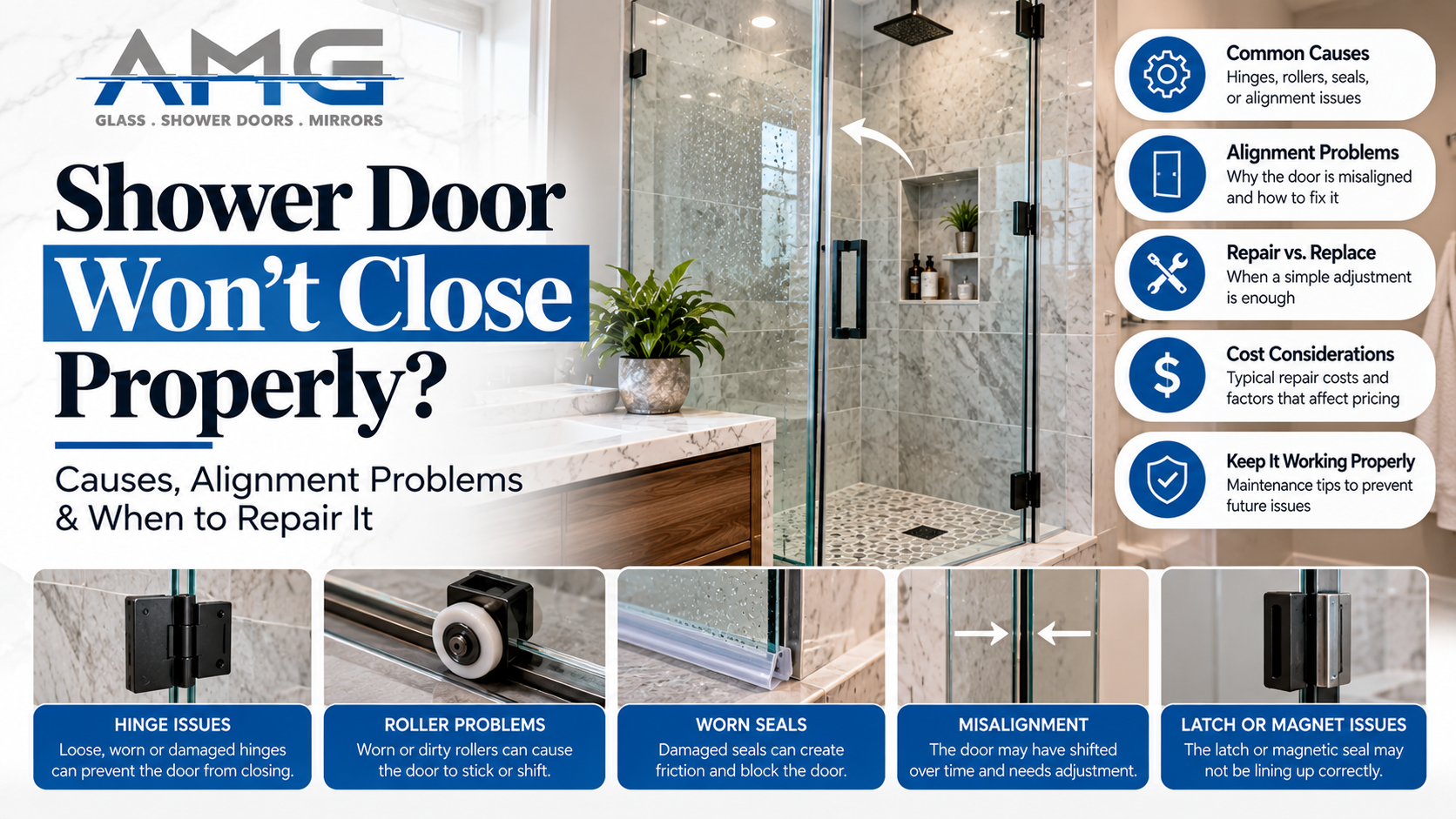
Quick Answer: If your shower door won’t close properly, the problem is often related to hinge alignment, loose hardware, worn rollers, damaged seals, an uneven track, or a door that has shifted out of position. A frameless shower door that suddenly stops lining up may be sagging under its own weight. A sliding door that will not shut completely may have worn rollers or an obstruction in the track. Some problems require only cleaning or replacement of a compatible seal, while others need professional adjustment or hardware replacement.
A glass shower door should close smoothly without scraping the floor, striking another glass panel, or requiring excessive force.
When it doesn’t, the problem can gradually become worse.
A minor alignment issue may eventually place unnecessary stress on hinges, mounting hardware, and the glass itself.
Before forcing the door closed or attempting to adjust it, it’s important to identify what is preventing normal movement.
This guide explains why shower doors stop closing properly, how to recognize different problems, which maintenance steps are reasonable for homeowners, and when professional shower door repair is the safer solution.
Why Is My Shower Door Not Closing All the Way?
A shower door may fail to close for several different reasons.
The most useful first step is to identify how the door behaves, rather than assuming that every problem comes from the hinges.
For example, a door that drags across the threshold has a different problem from a door that swings open immediately after being shut.
Similarly, a sliding door that stops halfway along its track requires a different inspection than a hinged frameless door that no longer lines up with its fixed glass panel.
Common Symptoms and What They May Mean
| What your shower door does | Possible cause | Recommended next step |
|---|---|---|
| Won’t close completely | Misalignment, obstruction, or damaged seal | Inspect gaps and contact points |
| Swings open after closing | Hinge mechanism, installation alignment, or gravity | Professional hinge and alignment inspection |
| Scrapes the bottom threshold | Sagging door or displaced hardware | Stop forcing it and inspect support |
| Hits the fixed glass panel | Door or panel out of alignment | Professional assessment |
| Slides halfway and stops | Track debris or damaged roller | Inspect and clean accessible track |
| Requires lifting to close | Roller, hinge, or support problem | Avoid forcing the door |
| Has an uneven gap at the top | Door alignment or wall movement | Inspect hinge and mounting conditions |
| Won’t latch or meet its seal | Seal damage or shifted alignment | Check seal condition and compatibility |
| Makes a popping noise | Binding hardware or glass contact | Stop using until assessed |
Not every symptom indicates that the entire shower enclosure needs replacement.
In many situations, the glass itself remains usable and the problem is limited to the hardware.
However, an unstable glass door should never be treated as a minor cosmetic issue.
1. Shower Door Hinges Have Shifted Out of Alignment
One of the most common reasons a hinged glass shower door stops closing correctly is a change in hinge alignment.
Frameless shower doors depend on a relatively small number of hinges to carry a substantial amount of weight.
Unlike traditional framed systems, the glass door does not have a complete surrounding metal frame to help control its position.
The hinges must maintain the correct relationship between the glass, the mounting wall, and the closing edge.
Why Do Hinges Lose Alignment?
Several conditions may contribute:
- Repeated opening and closing over time
- Hardware wear
- Improper original adjustment
- Loose mounting components
- Movement in the supporting structure
- Incorrect hinge selection for the door
- Excessive weight or force on the door
Not every change in alignment means the hinge itself has failed.
Sometimes the mounting structure has shifted, or another component has moved.
How to Recognize Hinge Alignment Problems
Close the door gently without forcing it.
Look at the space between the door and the adjacent wall or fixed panel.
The gap should follow the intended design and be consistent with the hardware manufacturer’s specifications.
Warning signs include:
- A noticeably wider gap at one end
- A closing edge that no longer lines up
- Glass rubbing against nearby surfaces
- A door that needs to be lifted to shut
- Hinges that appear tilted or loose
- A door that sits lower than it used to
Can Shower Door Hinges Be Adjusted?
Many hinges have adjustment procedures, but those procedures vary significantly by manufacturer.
Some systems allow limited changes in alignment.
Others require repositioning hardware or replacing worn components.
Do not loosen the hinge clamps on a heavy frameless glass door without properly supporting the glass and following the manufacturer’s instructions.
A sudden shift in a heavy panel can cause injury or damage.
If the door is sagging, binding, or contacting another glass panel, professional adjustment is recommended.
2. The Shower Door Is Sagging Under Its Own Weight
A sagging shower door is one that has dropped slightly from its original position.
This can be difficult to notice at first.
The door may still open normally but require extra effort to close.
Over time, it may begin rubbing against the curb, threshold, or neighboring glass.
How Heavy Is a Frameless Shower Door?
Frameless shower doors commonly use 3/8-inch or 1/2-inch tempered glass.
Consider a door that measures 28 inches wide and 76 inches tall.
| Glass thickness | Approximate glass weight |
|---|---|
| 3/8 inch | 59 pounds |
| 1/2 inch | 79 pounds |
These examples exclude hardware and are based on approximate glass weight.
The weight of the door must be safely supported by the hinges and mounting system.
That support becomes particularly important when the door is opened repeatedly.
What Causes Shower Door Sagging?
Possible causes include:
- Worn or improperly adjusted hinges
- Loose mounting screws
- Inadequate wall support
- Hardware not suited to the door’s dimensions
- Movement in the supporting structure
- Improper installation
- Excessive force applied to the door
A door should not gradually descend until it touches the floor or threshold.
Why Sagging Should Be Addressed Early
When a glass panel drops out of alignment, it may begin contacting surfaces that were not designed to carry its weight.
That can create concentrated pressure near glass edges.
Tempered glass is strong under appropriate loading, but its edges and corners can be vulnerable to damage.
Continuing to force a sagging door may increase the risk of hardware failure or glass breakage.
If the door is touching another hard surface, stop using it until the cause is evaluated.
3. Loose Shower Door Hardware Is Preventing Proper Closure
Shower doors rely on more than hinges.
Depending on the design, they may include clamps, pivots, handles, headers, brackets, stops, and mounting fasteners.
If one of these components becomes loose, the door may no longer move correctly.
What Loose Hardware Can Look Like
You may notice:
- A hinge plate separating slightly from the wall
- A handle that rotates or moves unexpectedly
- A clamp that appears displaced
- A bracket that shifts when the door moves
- Visible movement around the mounting area
- A door that suddenly changes position
It’s important to distinguish loose decorative hardware from loose structural support.
A handle that has become slightly loose may be relatively simple to address.
A hinge pulling away from a wall is much more serious.
Should You Tighten the Screws Yourself?
That depends on the component.
For a compatible handle or other nonstructural accessory, the manufacturer’s instructions may provide a straightforward maintenance procedure.
However, hinge clamps and structural mounting fasteners should not be randomly tightened.
Overtightening some glass hardware can damage components or create excessive pressure.
Undertightening can allow the glass to move.
The required torque and installation method depend on the specific hardware.
If the glass itself moves within a clamp, stop using the door and arrange a professional inspection.
4. A Damaged Shower Door Seal Is Blocking the Door
Not every closing problem involves metal hardware.
Sometimes the issue is a worn, displaced, or incompatible vinyl seal.
Glass shower doors may use seals along the bottom or vertical edges to help control water and cushion certain contact points.
Over time, these components can harden, deform, loosen, or become damaged.
How a Seal Can Prevent the Door From Closing
Imagine that your shower door has a vertical seal where it meets a stationary panel.
If that seal slips out of position, the door may press against it before reaching its intended closing position.
The result may feel like a hinge problem even though the door itself remains aligned.
Other symptoms include:
- A seal visibly folding when the door closes
- A vinyl strip hanging below the door
- The closing edge catching on a seal
- A magnetic seal that no longer meets its matching strip
- A replacement seal that is too thick
Can You Replace the Seal Yourself?
Some shower door seals are designed for straightforward replacement.
However, they are not all interchangeable.
Before purchasing a replacement, identify:
- Glass thickness
- Seal profile
- Mounting method
- Door configuration
- Manufacturer requirements
- Required length
A seal that looks similar in a photograph may not fit the same way.
Forcing an incorrect seal onto the glass can create additional closing problems.
When Seal Replacement Is the Right Solution
Replacing the seal may help when the door is otherwise correctly aligned and the obstruction clearly comes from worn or displaced vinyl.
If the door still fails to close after the seal problem is resolved, the hinges or other components may also need attention.
For other problems involving worn seals and water escaping from the enclosure, see our guide to shower door leaks and their causes.
5. Sliding Shower Door Rollers Are Worn or Damaged
Sliding shower doors operate differently from hinged systems.
Instead of swinging outward, glass panels travel along a track or rail using rollers, guides, or other supporting components.
When those parts become damaged, a door may stop before reaching its fully closed position.
Common Roller Problems
Roller-related symptoms may include:
- Grinding or scraping noises
- Uneven sliding
- Difficulty moving the panel
- A door that feels heavier than before
- A panel that tilts while moving
- A door that repeatedly catches at the same location
- Visible roller damage
Why Rollers Wear Out
Rollers experience repeated movement every time the shower is used.
Wear can develop from normal use, moisture exposure, contamination, misalignment, or deterioration of internal components.
In some systems, bearings may fail.
In others, the roller surface or mounting assembly may become damaged.
Can Sliding Door Rollers Be Replaced?
Often, yes.
Whether replacement is practical depends on the system and parts availability.
The replacement roller must match the track and panel requirements.
Important specifications can include:
- Wheel diameter
- Wheel profile
- Bearing and axle design
- Mounting method
- Glass thickness compatibility
- Weight rating
A roller that almost fits can still cause the panel to bind or move unpredictably.
When Roller Problems Become Serious
If a sliding panel appears to be lifting out of its guide or no longer securely supported, stop operating it.
Heavy glass panels should not be removed from their tracks without proper equipment and knowledge of the system.
Our shower door repair service can assess whether roller replacement, track service, or another repair is appropriate.
6. Dirt or Mineral Buildup Is Blocking the Shower Door Track
Before assuming that a sliding shower door needs new rollers, inspect the accessible portions of the track.
Bathrooms regularly expose shower hardware to water, soap residue, shampoo, body oils, and mineral deposits.
Over time, these materials can accumulate in track channels.
Signs That Track Buildup May Be the Problem
- The door gradually became harder to slide
- There is visible white or chalky residue
- Movement becomes difficult in one section
- Debris is visible around the track
- The door moves more smoothly after ordinary cleaning
How to Clean an Accessible Shower Door Track
- Inspect the track without removing the glass.
- Remove accessible loose debris using a soft brush.
- Apply a mild cleaner approved for the track finish.
- Gently clean accessible channels.
- Rinse or wipe away residue as permitted by the manufacturer.
- Dry the track.
- Test the door gently.
Avoid abrasive tools that could damage metal finishes.
Do not use strong acidic products unless the hardware manufacturer specifically permits them.
When Cleaning Isn’t Enough
If the door still binds after accessible buildup is removed, the problem may involve:
- Worn rollers
- Damaged track surfaces
- Misaligned guides
- A loose support rail
- A displaced panel
- Structural movement
Continuing to force the door may make the damage worse.
7. The Shower Door Is Hitting the Curb, Threshold, or Floor
A hinged shower door should have the clearances required by its design.
If the bottom edge starts rubbing against a threshold or curb, something may have changed.
Possible causes include:
- Door sagging
- Hinge misalignment
- Displaced bottom sweep
- Loose hardware
- A moving or damaged threshold component
- Improper original installation
How to Identify the Contact Point
Without forcing the door, observe where movement stops.
Does the glass itself contact the curb?
Does only the vinyl sweep rub?
Does the door scrape throughout its movement or only near the closed position?
These distinctions help identify the likely cause.
| Symptom | Possible explanation |
|---|---|
| Glass touches curb | Sagging or incorrect clearance |
| Vinyl drags on threshold | Displaced or unsuitable sweep |
| Door rubs near closing edge | Alignment issue |
| Door catches at one position | Hardware interference |
| Door suddenly begins scraping | Component movement or damage |
Why You Shouldn’t Shave Down the Glass
Tempered shower glass cannot be trimmed after tempering.
It also should not be ground, cut, or drilled on site to compensate for a closing problem.
Doing so can cause the panel to break.
The appropriate solution involves identifying the hardware or installation issue and correcting the configuration where feasible.
If the glass itself was fabricated incorrectly, replacement may be necessary.
8. The Magnetic Shower Door Seal No Longer Lines Up
Some shower enclosures use magnetic closure strips.
These systems typically have two matching magnetic components that meet when the door reaches the intended position.
If the strips are damaged, displaced, or incompatible, the door may not remain closed.
Signs of a Magnetic Seal Problem
- The door reaches the closing position but doesn’t stay there
- The magnetic strips no longer contact
- A section of the seal is loose
- One strip appears twisted
- The seal has become brittle or deformed
Is the Magnet Always the Problem?
No.
Magnetic strips may fail to meet because the door has shifted out of alignment.
For example, a sagging door may cause one magnetic strip to sit lower than the other.
Replacing the seal without correcting the alignment may not solve the problem.
What Should Be Checked?
A proper inspection should consider both the seal and the glass position.
The technician may need to identify whether the issue is:
- A worn magnetic strip
- A displaced seal
- A door alignment problem
- Incorrect replacement parts
- Movement in the mounting hardware
Once the actual cause is identified, the repair can be selected accordingly.
9. The Shower Door Was Installed Incorrectly
Sometimes a shower door has never closed properly.
This is different from a door that worked for years and gradually developed a problem.
If a new enclosure binds, scrapes, or refuses to stay in its intended position immediately after installation, the design or installation should be reviewed.
Possible problems include:
- Incorrect measurements
- Improper hinge selection
- Unsuitable hardware placement
- Inadequate structural support
- Incorrect glass dimensions
- Improper door alignment
- A track installed outside specified tolerances
- Insufficient clearance around the glass
Why Custom Shower Doors Need Precise Measurements
A bathroom opening may not be perfectly square.
If a door is fabricated using only one width measurement, variations elsewhere in the opening may be overlooked.
Professional measurement normally considers multiple points, finished tile surfaces, wall alignment, curb conditions, and hardware requirements.
The glass must be fabricated for the actual opening.
A door that is too large cannot simply be trimmed after tempering.
What If the Installer Says the Door Will Settle?
A properly installed shower door should operate according to the intended design after installation and any required adjustments.
A door that binds, strikes glass, or requires force should not be left in service on the assumption that it will eventually improve.
Contact the installer and document the symptoms.
If the original installer is unavailable, an independent glass technician may be able to evaluate the enclosure.
Shower Door Closing Problems: Hinged vs. Sliding Systems
Although both systems can fail to close properly, they often develop different mechanical problems.
| Feature | Hinged glass shower door | Sliding glass shower door |
|---|---|---|
| Main movement | Rotates on hinges or pivots | Travels along a rail or track |
| Common hardware issue | Hinge misalignment | Roller wear |
| Common obstruction | Seal, curb, or adjacent panel | Track debris or damaged guide |
| Typical symptom | Sagging or uneven gaps | Sticking or uneven sliding |
| Repair possibility | Adjustment or hardware replacement | Cleaning, roller, or track service |
| Major concern | Unstable hinged glass | Panel leaving its support system |
How to Tell Which Repair Is Likely
If your hinged shower door hangs lower on one side, the technician should evaluate the hinge and mounting assembly.
If a sliding door becomes difficult to move and produces grinding noises, the rollers and tracks deserve attention.
If either type of door has cracked glass or unstable structural hardware, the priority becomes safety rather than routine adjustment.
Why Does My Shower Door Keep Swinging Open by Itself?
A door that moves open after being placed in the closed position can be frustrating.
It may also be a sign that the hardware or installation alignment needs attention.
Possible Causes
Hinge mechanism: Some hinges have closing or holding characteristics built into their design. Wear or incorrect adjustment may affect performance.
Door alignment: A door that is no longer positioned correctly may fail to reach its intended resting position.
Gravity: If the hinge axis is not correctly aligned, the weight of the door may encourage movement.
Seal resistance: A deformed seal can prevent the door from reaching its proper closing position.
Hardware incompatibility: Replacement hinges or seals may not operate correctly with the original enclosure.
Should You Add a Stronger Magnet?
Not automatically.
A stronger magnetic strip will not fix an unstable hinge or incorrectly mounted glass.
The underlying problem should be identified before adding hardware.
If the door moves unexpectedly or cannot remain safely positioned, arrange an inspection.
Why Does My Shower Door Close at the Top but Leave a Gap at the Bottom?
An uneven vertical closing gap is a useful diagnostic clue.
It can indicate that the door and adjacent surface are no longer aligned as intended.
Possible reasons include:
- A sagging hinge
- A shifted fixed panel
- Movement in the mounting structure
- Improper original fabrication
- A displaced seal
- Walls that are out of plumb
Does an Uneven Gap Always Mean the Door Is Broken?
No.
Some frameless shower doors are intentionally fabricated to accommodate walls that are not perfectly straight.
The actual glass gap should be evaluated against the approved design.
A gap that has existed since installation may be different from one that recently appeared.
What If the Gap Is Getting Wider?
A changing gap suggests movement or deterioration.
Take a photograph showing the door fully closed without forcing it.
Compare that photograph with earlier images if available.
A technician can use this information to help determine whether the door, panel, hinges, or surrounding structure has moved.
If the glass begins contacting another hard surface, stop using it.
Can You Fix a Shower Door That Won’t Close Without Replacing It?
Often, yes.
Many closing problems are caused by components that can be cleaned, adjusted, or replaced.
However, repair feasibility depends on the condition of the glass, the hardware system, and the supporting structure.
Problems That May Be Repairable
| Problem | Possible repair |
|---|---|
| Worn seal | Compatible seal replacement |
| Minor track buildup | Cleaning and maintenance |
| Worn roller | Matching roller replacement |
| Loose nonstructural handle | Manufacturer-approved adjustment |
| Hinge misalignment | Professional adjustment |
| Worn hinge | Compatible hinge replacement |
| Damaged guide | Replacement of matching component |
When Replacement May Be Necessary
A complete door or enclosure replacement may be more appropriate when:
- The glass is cracked or chipped
- Structural hardware is badly damaged
- The mounting wall cannot safely support the enclosure
- The original hardware has been discontinued
- The glass was fabricated to incorrect dimensions
- Multiple components have deteriorated
- The repair would not provide a reliable result
A repair assessment should determine whether the existing enclosure can safely remain in use.
What Should You Never Do to a Glass Shower Door That Won’t Close?
Some common DIY approaches can make the situation worse.
Don’t Force the Glass Against the Frame
Repeated pressure can create stress at contact points.
If the door stops moving, identify the obstruction instead of forcing it through.
Don’t Lift a Heavy Frameless Door by the Handle
Handles are not designed to serve as lifting equipment for the entire glass panel.
Lifting or pulling excessively can damage hardware.
Don’t Loosen Structural Hinges Without Supporting the Door
A heavy glass panel may move unexpectedly when clamps or fasteners are loosened.
Don’t Grind Down Tempered Glass
Tempered shower glass cannot be resized after tempering.
Don’t Use Random Lubricants
Some lubricants can damage seals, attract dirt, or be incompatible with roller systems.
Follow the hardware manufacturer’s instructions.
Don’t Ignore Cracked or Chipped Glass
A crack or edge chip can compromise tempered glass.
Stop using the door and arrange professional evaluation.
Don’t Continue Using a Door With Loose Wall Mounting
If hinges or brackets visibly move away from the wall, the issue may involve the mounting structure.
That requires prompt attention.
How Much Does It Cost to Repair a Shower Door That Won’t Close?
The cost depends on the component that failed, parts availability, and the amount of labor required.
A simple compatible seal replacement is different from replacing structural hinges or correcting an unstable mounting assembly.
Rather than assuming one price applies to all repairs, ask for an estimate that identifies the problem and proposed work.
What Affects Repair Pricing?
- Type of shower door
- Hardware manufacturer
- Availability of replacement parts
- Glass size and weight
- Accessibility of the installation
- Condition of the mounting wall
- Whether glass removal is required
- Extent of the alignment problem
Is It Cheaper to Repair or Replace?
In many cases, repairing a sound enclosure costs less than replacing the entire glass system.
However, this is not universal.
If the wall support has failed, the glass is damaged, or essential hardware is unavailable, replacement may offer better long-term value.
A repair quote should explain why the recommended work is appropriate.
At Glass and Shower Doors, our technicians evaluate shower doors and related hardware to help homeowners understand their options.
Request a Shower Door Repair Estimate
Can an Older Shower Door Still Be Repaired?
Many older shower doors can be repaired, but compatibility becomes increasingly important.
A shower enclosure installed 10, 15, or 20 years ago may use hardware that is no longer manufactured.
That does not automatically mean the glass must be replaced.
However, the technician must determine whether compatible components are available.
Why Matching Hardware Matters
Hinges, rollers, seals, and guides are designed around particular dimensions and load requirements.
Substituting an unsuitable part can lead to poor performance or unsafe operation.
A component that looks similar may have different mounting dimensions or weight ratings.
What If Replacement Parts Are Discontinued?
Possible solutions depend on the enclosure.
Sometimes an approved compatible component is available.
In other situations, replacing the door or larger enclosure may be the more practical option.
Improvised mounting solutions should not be used to compensate for inadequate structural compatibility.
How to Prevent Shower Door Alignment Problems
Not every hardware problem can be prevented, but routine maintenance can help identify issues before they become severe.
Keep Tracks Clean
For sliding systems, remove accessible soap residue and mineral buildup according to the manufacturer’s cleaning instructions.
Inspect Seals Periodically
Look for brittle, loose, or displaced vinyl.
Replace worn seals with correctly sized components.
Avoid Hanging Heavy Items on the Glass Door
Hanging heavy towels, organizers, or other objects from handles can add unnecessary loads.
Open and Close the Door Gently
Avoid slamming the door or allowing it to strike hard surfaces.
Pay Attention to New Noises
Grinding, clicking, scraping, or popping sounds can indicate a developing problem.
Watch for Changes in Door Position
If a door begins sitting lower or leaving a different gap, arrange an inspection before it becomes unstable.
Use Appropriate Cleaning Products
Harsh or abrasive cleaners may damage certain metal finishes, seals, or protective coatings.
Follow the manufacturer’s recommendations.
When Should You Call a Professional Shower Door Repair Technician?
You should arrange professional evaluation if:
- The door is visibly sagging
- The glass touches the floor, curb, or another panel
- Hinges move within their mounts
- The door requires lifting to close
- A sliding panel threatens to leave its track
- The door will not remain in its intended position
- Hardware makes loud popping or grinding sounds
- Glass is chipped or cracked
- You cannot identify compatible replacement parts
- A recent installation has never worked correctly
If the enclosure is unstable, discontinue use until it is evaluated.
A professional glass technician can assess the hardware, alignment, and existing glass to determine whether repair is appropriate.
For additional information, visit our shower door repair services in Chicago.
Frequently Asked Questions About Shower Doors That Won’t Close
Why Won’t My Frameless Shower Door Close All the Way?
Common causes include hinge misalignment, a sagging glass panel, displaced seals, or contact with the curb or adjacent glass. The specific cause should be identified before adjusting the hardware.
Why Does My Shower Door Keep Opening After I Close It?
The hinge mechanism, door alignment, seal, or mounting position may be preventing the door from remaining closed. A professional should inspect a door that repeatedly swings open unexpectedly.
Can Shower Door Hinges Be Adjusted?
Many hinge systems allow some adjustment, but the procedures vary. Heavy glass should be properly supported during structural hardware adjustments.
Why Does My Shower Door Scrape the Bottom?
The glass may have sagged, the hinge may have shifted, or a bottom seal may be displaced. Avoid forcing the door until the contact point is identified.
Can You Replace Shower Door Hinges Without Replacing the Glass?
Often, yes, if compatible replacement hinges are available and the glass and mounting structure remain sound.
Why Won’t My Sliding Shower Door Shut Completely?
Potential causes include debris in the track, worn rollers, damaged guides, or a misaligned panel.
What Causes a Shower Door to Become Crooked?
Hinge movement, hardware wear, installation errors, or shifts in the supporting structure can change alignment.
Can a Worn Shower Door Seal Prevent Closing?
Yes. A damaged or incorrectly fitted seal may interfere with the door reaching its intended position.
Should I Keep Using a Shower Door That Is Sagging?
No, not if the door is contacting other surfaces, has unstable hardware, or appears unsafe. Have it evaluated before continued use.
Can a Shower Door Be Repaired if the Manufacturer Is Unknown?
Sometimes. A technician may be able to identify compatible components by inspecting the existing hardware. If safe compatible parts are unavailable, replacement may be necessary.
Is a Shower Door That Won’t Close Always a Sign It Needs Replacement?
No. Many problems involve serviceable hardware or seals. Replacement is generally considered when the glass, structural support, or essential components cannot be safely restored.
Can You Adjust a Glass Shower Door Yourself?
Minor cleaning and certain manufacturer-approved maintenance tasks may be appropriate for homeowners. Structural hinge and glass alignment work should be performed by someone trained to handle the system.
How Long Does Shower Door Repair Take?
The timeline depends on the issue and parts availability. Some adjustments and seal replacements can be completed during a service visit, while specialized components may require ordering.
Can a Shower Door Break Because It Is Misaligned?
Misalignment can create unintended contact or concentrated stress. Tempered glass edges can be vulnerable to impact and damage, so binding or unstable doors should be inspected promptly.
Get Your Shower Door Closing Properly Again
A shower door that won’t close correctly may be dealing with a relatively simple hardware problem—or an issue that requires more extensive repair.
The important step is finding the cause before unnecessary damage occurs.
At Glass and Shower Doors, we bring 25 years of glass fabrication and installation experience to homeowners throughout Chicago and the surrounding suburbs.
We work with frameless, semi-frameless, and sliding shower doors, including existing enclosures installed by other companies.
Whether your shower door is sagging, sticking, scraping, or refusing to close, we can evaluate the condition of the glass and hardware and recommend an appropriate solution.
Glass and Shower Doors
4711 W 135th St, Crestwood, IL 60418
Call or Text: (708) 808-7775
Learn more about our shower door repair services or explore custom frameless shower door options if replacing an older enclosure is the better solution.