Hard Water Damage on Shower Glass: Why It Happens and How to Stop It
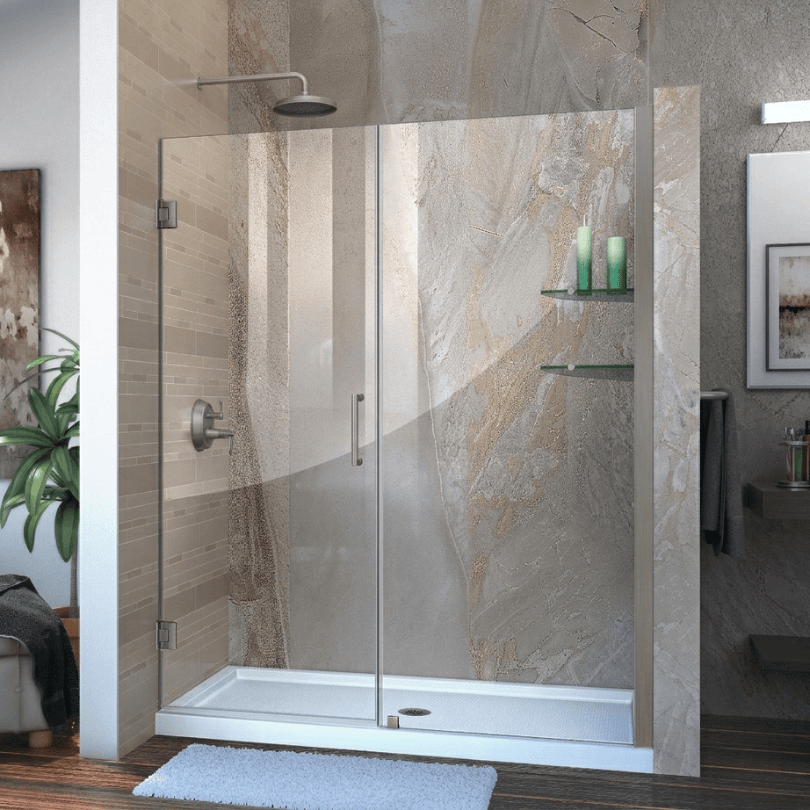
If you live anywhere in the greater Chicago area and have owned a glass shower door for more than a year or two, you have probably noticed it: a hazy, whitish film that will not wipe away no matter how hard you scrub. Most people call it soap scum, and sometimes that is exactly what it is. But often, what is actually happening is something more permanent, and understanding the difference is the only way to know whether you are looking at a cleaning problem or a glass that needs to be replaced.
This is one of the most common questions we hear on service calls, and it is worth understanding in detail, because the wrong assumption leads to a lot of wasted money on cleaning products that were never going to fix the actual problem.
What Hard Water Actually Does to Glass
Chicago and most of its suburbs draw from Lake Michigan and groundwater sources that carry a meaningful amount of dissolved calcium and magnesium. That is what “hard water” means. When that water lands on glass and evaporates, which happens constantly in a shower, it does not just disappear. The minerals it was carrying stay behind on the surface.
At first, that mineral residue sits on top of the glass. This is the buildup stage, and it is genuinely just a cleaning problem. A film of calcium and magnesium deposits sitting on the surface can be dissolved and wiped away with the right approach, which we cover below.
Left alone long enough, that same mineral residue starts to do something different. The minerals interact chemically with the silica in the glass surface itself, and over months or years, this creates microscopic pitting in the glass. This is etching, and it is not a coating sitting on top of the glass anymore. It is damage to the glass itself. No cleaner, no matter how strong, restores glass that has been etched, because there is no longer a clean surface underneath the buildup to reveal. The surface itself is now uneven at a microscopic level, and that unevenness is what scatters light and creates the permanent hazy or cloudy look.
How to Tell the Difference
This distinction matters because it determines whether you need a bottle of cleaner or a new panel of glass, and there is a simple way to check.
- Run your fingernail flat across the hazy area. If it feels smooth, what you are looking at is very likely buildup sitting on the surface. If it feels gritty, rough, or slightly bumpy, that texture is the etching itself.
- Try a vinegar soak. Lay a vinegar-soaked paper towel or cloth against the glass for fifteen to twenty minutes, then wipe. If the haze significantly lightens or disappears, it was buildup. If it looks essentially the same afterward, the damage has already reached the glass.
- Check for a directional pattern. Etching from hard water tends to follow the path water actually traveled and dried, often heaviest near the bottom of the panel or wherever spray hits most directly. Buildup can be more evenly distributed since it accumulates from ambient humidity as well as direct contact.
If you are unsure which one you are dealing with, we are happy to take a look at photos before you spend money on cleaning products that will not help. Call or text (708) 808-7775.
If It Is Buildup: How to Actually Clean It
For buildup that has not yet etched the glass, a few approaches work reliably, and none of them require anything exotic.
- A plain white vinegar and water solution, roughly equal parts, applied and left to sit for several minutes before wiping, breaks down mineral deposits effectively on most glass.
- For buildup that has hardened over a longer period, a paste of baking soda and a small amount of water applied with a soft cloth, not an abrasive pad, adds gentle mechanical action without scratching the surface.
- A squeegee used after every single shower, before the water has a chance to evaporate and leave minerals behind, is by far the most effective long-term prevention. This one habit does more than any cleaning product applied after the fact.
One thing to avoid entirely: abrasive scouring pads, steel wool, or any cleaner with grit in it. These can scratch glass immediately, and a scratch is permanent in the same way etching is. You can trade a fixable buildup problem for an unfixable scratch problem in about thirty seconds with the wrong tool.
If It Is Etching: Why Replacement Is the Only Real Fix
Once hard water has actually etched the glass, there is no cleaning product, polish, or treatment on the market that restores the original clarity, because the damage is not a surface layer, it is a change to the glass itself. Some companies sell glass polishing or resurfacing services that grind down a very thin layer of the glass to remove light etching, but this is a specialized process, it does not work on deep etching, and it changes the panel’s thickness and edge profile in ways that are not always practical on a tempered shower panel.
For most homeowners dealing with etched shower glass, replacing the affected panel is the straightforward path forward. This does not necessarily mean rebuilding the entire enclosure. If only one panel has taken the damage, in many cases that single panel can be measured and replaced to match the rest of the enclosure, which our team covers in detail on our shower door repair services page.
Preventing It From Happening Again
Whether you are dealing with a current etching problem or you just installed new glass and want to keep it looking that way, prevention comes down to a short list of habits and, if the water in your home is particularly hard, one equipment decision.
- Squeegee after every shower. This is the single highest-impact habit. It takes under a minute and prevents the evaporation cycle that deposits minerals in the first place.
- Wipe down weekly with a proper glass cleaner. Even with squeegeeing, a weekly pass with a non-abrasive glass cleaner catches anything that got missed.
- Consider a water softener if your hardness is high. Much of the Chicago area has moderately to significantly hard water, and a whole-home softener reduces the mineral load hitting every glass surface, fixture, and appliance in the house, not just the shower.
- Ask about a protective glass coating at install. A coating applied to new glass makes water bead and roll off rather than sheeting and drying in place, which meaningfully slows both buildup and eventual etching. This is worth asking about specifically if squeegeeing every single day is not realistic for your household.
When You Are Ready for New Glass
If your existing enclosure has reached the point where etching has taken hold and a fresh look is the goal, it is worth thinking through enclosure type at the same time, since some styles are genuinely easier to keep ahead of hard water than others. Our frameless shower doors page and our semi-frameless shower doors page both cover how each style handles daily cleaning and long-term upkeep, which is worth a look if you are replacing glass anyway and want to make the next enclosure lower maintenance than the last one.
For homes anywhere in the greater Chicago area, we measure the existing opening, match glass to your current enclosure when a single panel needs replacing, or build a full new enclosure when it is time for a change. If you are also working with a tighter bathroom footprint, our post on shower doors for small bathrooms covers enclosure types that make the most of limited floor space. Call or text (708) 808-7775 for a free, no obligation estimate.