
Can You Replace a Shower Curtain With Glass Doors on an Existing Bathtub?
By Abdullah Ghabayen, Glass and Shower Doors · 25 years of glass fabrication and installation across Chicago and the suburbs · Updated October 26, 2026
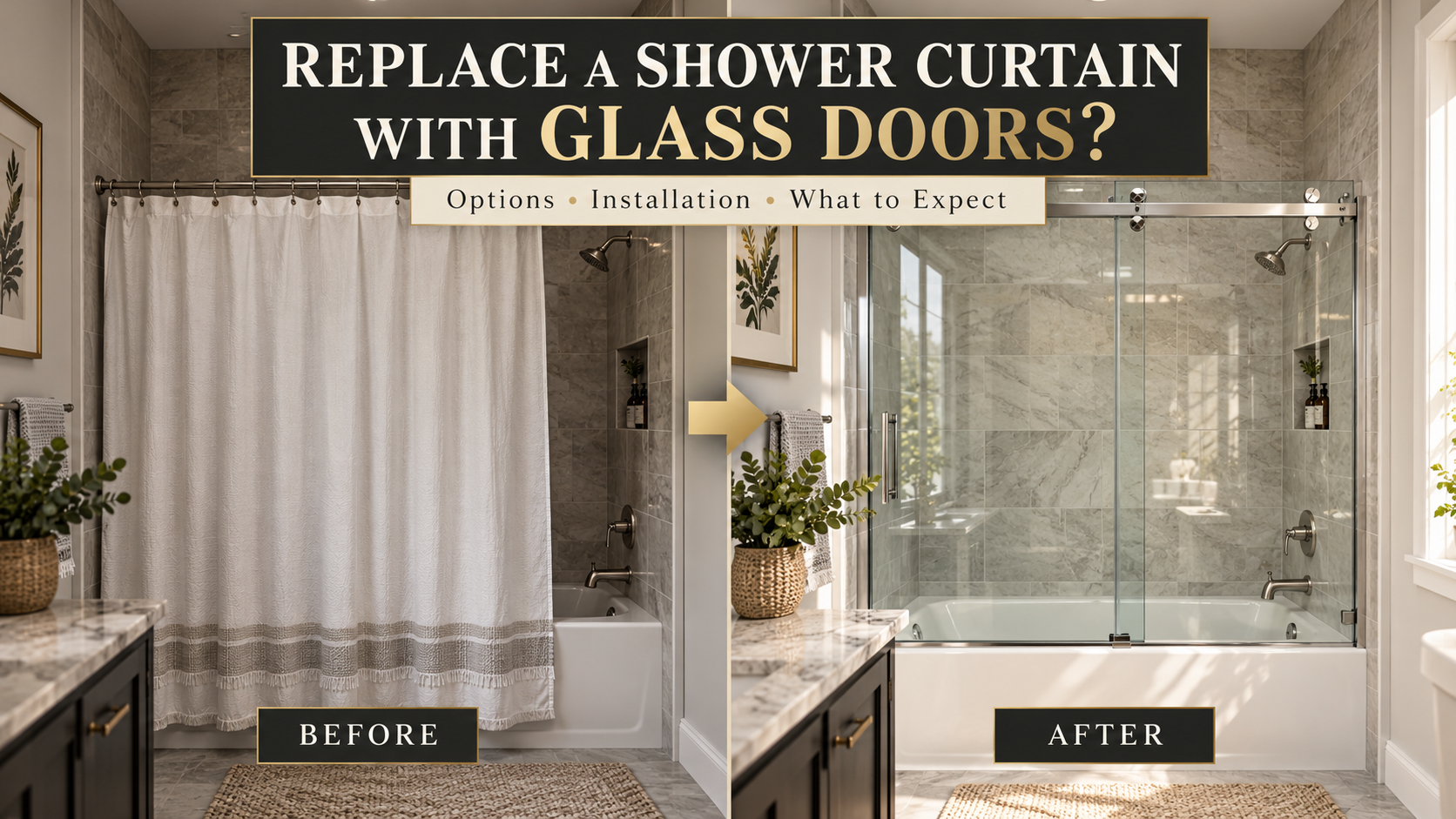
Quick Answer: Yes, you can replace a shower curtain with glass doors on an existing bathtub in many bathrooms without replacing the tub or remodeling the surrounding tile. Sliding glass bathtub doors are often a practical choice because they don’t require outward swing clearance. Hinged glass bath screens and custom enclosures may also work, depending on the bathtub’s rim, wall conditions, mounting support, and available bathroom space. The key is confirming that the existing tub and walls are suitable for the selected glass system.
If you’re tired of dealing with a shower curtain that sticks to you, blows inward, or allows water to escape onto the bathroom floor, glass doors may be an attractive alternative.
A glass enclosure can make a bathtub-and-shower combination look more finished while preserving the existing bathtub.
This is especially appealing to homeowners who want to update a hallway bathroom or guest bathroom without investing in a complete renovation.
But there’s an important distinction between installing glass over a bathtub and installing a door on a walk-in shower.
Bathtubs have curved or narrow rims, specific wall conditions, and clearance limitations that must be considered before purchasing glass.
Not every bathtub can accommodate every type of shower door.
This guide explains which glass systems work over existing tubs, how installation works, what to inspect, and when a custom enclosure is the better option.
Can You Install Glass Shower Doors on a Bathtub You Already Have?
In many cases, yes.
A bathtub does not need to be brand-new to accommodate glass doors.
Many existing bathtubs are installed in a three-wall alcove, with plumbing fixtures at one end and a finished wall at the other.
This creates a space that may be suitable for a sliding glass enclosure.
Unlike a shower curtain, which hangs from a rod and moves freely, glass doors form a defined barrier along the bathtub opening.
The installation usually involves mounting an approved door system to the surrounding walls and, where the system requires it, attaching compatible components along the bathtub rim.
When Glass Doors May Be a Good Option
A bathtub may be suitable when:
- The tub is securely installed
- The surrounding walls are in good condition
- The bathtub rim can accommodate the chosen system
- The mounting surfaces provide adequate support
- The wall and tub waterproofing are functioning properly
- The glass can be measured to fit the opening
- The bathroom provides suitable entry and exit access
When Glass Doors May Not Be Appropriate
Installation may be difficult when:
- The bathtub rim is too narrow for the selected track
- The tub has an unusual curved or irregular edge
- The surrounding walls are damaged
- The required mounting structure is inadequate
- The bathtub moves or flexes excessively
- The opening is unsuitable for the proposed door configuration
- The enclosure would interfere with another bathroom fixture
These conditions do not always rule out glass, but they may require a different system or corrective work.
The most important step is evaluating the actual bathtub, not simply choosing a door based on its advertised width.
1. What Types of Glass Doors Can Replace a Shower Curtain?
There are several ways to enclose a bathtub with glass.
The right choice depends on the opening, bathroom layout, desired appearance, and budget.
Sliding Glass Bathtub Doors
Sliding doors are one of the most common replacements for shower curtains on alcove bathtubs.
A typical bypass system uses two overlapping glass panels.
One or both panels slide horizontally along a track or rail.
Because the glass moves across the bathtub opening rather than outward into the room, it can be especially practical in smaller bathrooms.
Advantages:
- No conventional outward door swing
- Suitable for many standard bathtub alcoves
- Helps control water splashing
- Available in different glass styles and finishes
- Can work in bathrooms with nearby toilets or vanities
However, the system must be compatible with the tub rim and wall conditions.
Semi-Frameless Bathtub Doors
Semi-frameless systems combine glass panels with selected framing components.
They can provide a cleaner appearance than a fully framed enclosure while retaining some structural framing.
Depending on the product, the system may offer limited adjustment for minor wall irregularities.
This can be useful in older bathrooms, although every system has specific installation tolerances.
Frameless Sliding Tub Enclosures
Some modern sliding systems use heavier glass and relatively minimal visible framing.
They may be selected when the homeowner wants a more open or upscale appearance.
However, frameless-style sliding systems still require approved rails, rollers, guides, and mounting hardware.
They’re not automatically suitable for every existing bathtub.
Hinged Glass Bath Screens
A hinged bath screen usually covers only part of the tub opening.
Instead of enclosing the entire bathtub, a single glass panel extends from the wall near the showerhead.
This can create a more open appearance.
However, it must provide adequate water control.
A short panel may allow splashing beyond its edge, particularly if the showerhead directs water toward the open section.
Fixed Glass Bathtub Panels
A stationary panel may also replace part of a shower curtain.
Like hinged bath screens, fixed panels work best where the shower layout is appropriate for partial enclosure.
The bathtub must still provide safe and practical access.
Glass Door Options Compared
| Glass option | Swing space | Coverage | Main consideration |
|---|---|---|---|
| Sliding glass doors | None outside tub | Typically most of opening | Track and rim compatibility |
| Semi-frameless sliding | None outside tub | Typically most of opening | Frame fit and wall tolerance |
| Frameless-style sliding | None outside tub | Typically most of opening | Support and hardware requirements |
| Hinged bath screen | May require swing space | Partial | Splash control and clearance |
| Fixed bath screen | None | Partial | Open section and water direction |
2. Are Sliding Glass Doors Better Than a Shower Curtain?
For many homeowners, sliding glass doors can improve the appearance and everyday function of a bathtub-and-shower combination.
But the choice depends on how the bathroom is used.
Better Water Control in Some Layouts
A shower curtain must be positioned correctly to keep water inside the bathtub.
If the curtain moves, bunches up, or doesn’t extend properly along the tub, water may escape.
A correctly installed sliding enclosure creates a more consistent barrier.
However, glass doors are not a substitute for functioning waterproofing.
They also cannot prevent every possible leak, especially if the bathtub or surrounding wall assembly has existing problems.
A More Permanent Appearance
A glass enclosure can make a bathroom look more finished.
Clear glass allows the surrounding tile and bathtub interior to remain visible.
For homeowners who recently updated their tile, this may be especially appealing.
Different Cleaning Requirements
Glass doors eliminate the fabric or vinyl curtain, but introduce glass, tracks, seals, and hardware that require maintenance.
Water spots can develop on glass.
Soap residue can collect in tracks.
Rollers and seals may eventually require servicing.
The best option depends on whether you prefer caring for a glass enclosure or regularly cleaning and replacing curtains.
Bathtub Accessibility
This is an important consideration that homeowners sometimes overlook.
A shower curtain can be moved completely out of the way.
A sliding glass enclosure leaves tracks and panel overlap that may limit how freely a person can access the tub.
For families bathing small children or assisting someone with limited mobility, this difference matters.
Shower Curtain vs. Glass Door
| Feature | Shower curtain | Sliding glass doors |
|---|---|---|
| Initial cost | Usually lower | Higher |
| Appearance | Flexible and decorative | Permanent glass finish |
| Water containment | Depends on curtain position | More defined barrier |
| Cleaning | Curtain and liner | Glass, seals, tracks |
| Bathing children | Often easier access | Panels and track may restrict access |
| Maintenance | Replace liner or curtain | Maintain glass and hardware |
| Installation | Usually simple | Requires suitable mounting |
3. Can You Install Glass Doors on a Standard 60-Inch Bathtub?
Many alcove bathtubs are approximately 60 inches long.
This is a common layout in older and newer residential bathrooms.
However, the manufacturer’s nominal bathtub length does not necessarily equal the finished wall-to-wall opening.
Tile thickness, wall alignment, and the exact bathtub model all affect the dimensions.
Why You Should Measure the Finished Opening
A tub described as 60 inches may have an opening that differs from that measurement.
The installer should measure between the finished walls at multiple heights.
For example, an older bathtub alcove might measure:
- 59⅞ inches near the bottom
- 60 inches at the middle
- 60¼ inches near the top
These are illustrative measurements, not standard tolerances.
Small differences can affect the fit of a sliding door system.
Do Standard Glass Doors Adjust to Uneven Walls?
Some products include adjustable wall profiles.
However, the adjustment range is limited.
A wall that is significantly out of plumb may require another system or custom fabrication.
Does the Bathtub Length Determine the Door Height?
No.
The correct glass height depends on the tub rim, wall conditions, showerhead location, ceiling clearance, and system specifications.
A bathtub enclosure typically does not need to extend all the way to the ceiling.
The glass must be tall enough for the intended water-control performance without interfering with fixtures or other building features.
4. Does the Bathtub Rim Need to Be Flat for Glass Doors?
The bathtub rim is one of the most important installation considerations.
A shower curtain does not require a rigid mounting track along the tub edge.
Many glass door systems do.
What Is the Bathtub Rim?
The rim is the upper edge of the tub surrounding its bathing basin.
Its shape varies by bathtub style.
Some rims are relatively flat and wide.
Others are narrow, rounded, sloped, or decorative.
Why Rim Shape Matters
A bottom track or guide must fit and be supported in the manner required by the manufacturer.
If the rim is too narrow, a conventional track may not fit properly.
If the rim is significantly curved, it may not provide the contact surface the system requires.
An installer should not assume that a track can be attached to every tub.
Can Glass Doors Be Installed on a Curved Bathtub?
Sometimes.
The answer depends on whether the selected system can accommodate the rim geometry.
Some configurations may require an alternative guide arrangement or a different enclosure design.
However, modifying the bathtub or improvising an unsupported track should not be treated as a routine solution.
What if the Tub Rim Slopes Inward?
The slope must be evaluated together with the door system.
In some tubs, the upper surface is designed to direct water inward.
That can be beneficial for water control.
However, the selected hardware must still be compatible with the available mounting surface.
How Can You Check Your Rim?
You can take photographs showing:
- The full bathtub
- The rim from above
- Both tub-to-wall corners
- The showerhead location
- Any existing damage or uneven areas
These photographs can help an installer assess possible configurations before taking final measurements.
5. Can You Install Glass Doors on an Acrylic or Fiberglass Bathtub?
Yes, certain glass systems can be installed with acrylic or fiberglass bathtubs.
However, compatibility depends on the exact bathtub and door manufacturers’ instructions.
Acrylic and fiberglass tubs have different construction characteristics from cast iron or enameled steel models.
Some surfaces may flex under load.
Others require specific fastening or support methods.
Why Tub Material Matters
The installation must account for:
- The strength of the rim
- Surface compatibility with sealants
- Manufacturer-approved attachment methods
- Potential surface flex
- Existing damage
- Long-term water exposure
Should You Drill Into an Acrylic Bathtub?
Do not assume drilling is permitted.
Some bathtub manufacturers restrict holes through specific surfaces because they may damage the tub, affect waterproofing, or void warranties.
A compatible glass system may use approved methods that avoid certain penetrations.
The installation should follow the applicable manufacturer specifications.
What About Fiberglass Tub Surrounds?
A fiberglass tub-and-wall surround is different from a bathtub with separate tile walls.
Some surrounds have hollow spaces or limited structural support behind the finished surface.
Heavy glass hardware must not be fastened into an unsuitable wall assembly.
The installer must confirm the mounting method and supporting structure.
When Another Configuration May Be Better
If the tub or surround cannot safely support the desired glass system, a different enclosure may be necessary.
In some cases, keeping a curtain is preferable to installing incompatible glass hardware.
6. Can You Install Glass Doors Over an Existing Cast-Iron Bathtub?
Many older homes contain cast-iron bathtubs.
These tubs can remain in excellent condition for decades, even when the surrounding bathroom finishes become outdated.
A cast-iron tub does not automatically prevent glass door installation.
However, the exact rim shape and surrounding wall conditions still matter.
Older Bathtubs May Have Unusual Dimensions
Not every older bathtub matches current standard products.
Some have:
- Narrow rims
- Rounded edges
- Unusual wall-to-wall dimensions
- Older tile surfaces
- Slightly uneven alcove walls
A custom measurement is especially important when replacing a curtain on an older tub.
Will Glass Damage the Bathtub Finish?
A properly selected system should be installed using methods compatible with the tub’s finish.
However, improper drilling, tools, or fasteners can damage surfaces.
Existing chips or deterioration should be evaluated before installation.
Should You Replace an Old Tub Before Adding Glass?
Not necessarily.
If the tub is structurally sound, properly installed, and in good condition, replacing it solely to add glass may be unnecessary.
But if the tub has leaks, severe deterioration, or mounting limitations, those issues may need to be addressed first.
7. Can You Replace a Shower Curtain Without Removing the Tile?
Often, yes.
Installing glass doors over an existing bathtub usually does not require removing the surrounding tile when the walls are suitable.
The installer measures the finished opening and determines where approved hardware can be secured.
What Happens to the Existing Curtain Rod?
The curtain rod is typically removed.
If it was mounted with screws, the old mounting holes may require appropriate repair.
If it was a tension rod, removal may leave little or no visible wall damage.
Do Glass Doors Require New Holes in Tile?
Many systems require wall-mounted hardware.
Depending on the configuration, drilling into the finished wall may be necessary.
The installer must consider the tile, waterproofing, and underlying structural support.
Can Drilling Damage the Tile?
Yes, improper drilling can crack tile.
Porcelain, ceramic, and natural stone have different drilling characteristics.
A professional should use the appropriate tools and techniques.
The mounting assembly must also be structurally suitable.
Tile alone should not be assumed capable of supporting heavy glass hardware.
For an in-depth explanation of finished-wall considerations, our related article about installing glass on an existing tiled shower can provide further guidance once its published URL is confirmed.
8. What if the Toilet Is Too Close to the Bathtub?
This is one reason sliding bathtub doors are popular.
In many bathrooms, the toilet sits directly beside the tub.
A swinging glass door could interfere with the toilet, vanity, or bathroom walking space.
Why Sliding Doors Help
Sliding panels travel along the bathtub opening.
They do not require a conventional door swing into the room.
This can preserve usable floor space in a compact bathroom.
Can You Use Hinged Glass Instead?
Possibly.
A hinged bath screen may work when there is appropriate clearance and the selected system complies with applicable requirements.
However, the entire swing path must be evaluated.
The door should not strike the toilet or another fixture.
What About Narrow Hallway Bathrooms?
These bathrooms often have a bathtub along one wall, a vanity opposite it, and a toilet positioned nearby.
A sliding enclosure may fit the layout better than a large hinged panel.
However, access to the tub also matters.
A family that regularly bathes young children may find a fixed or sliding glass enclosure less convenient than a curtain.
9. Can You Install Frameless Glass Doors Over a Bathtub?
Yes, but the term frameless can describe several different configurations.
Some bathtub systems use thick glass, minimal framing, and specialized sliding hardware.
Others use a hinged glass bath screen.
A fully frameless appearance does not mean the glass operates without supporting components.
What Makes Frameless Glass Different?
Frameless shower systems often use thicker glass than conventional framed doors.
The exact thickness depends on the design and hardware.
Common frameless glass thicknesses include 3/8 inch and 1/2 inch.
These panels can be heavy.
For example, a 30-by-60-inch glass panel weighs approximately:
| Glass thickness | Approximate glass weight |
|---|---|
| 3/8 inch | 50 pounds |
| 1/2 inch | 67 pounds |
These are approximate glass-only weights.
The selected hardware and wall support must be suitable for the panel dimensions and loads.
Does Frameless Glass Cost More?
Custom frameless systems often cost more than basic framed or semi-frameless enclosures.
They may require heavier glass, specialized hardware, and more precise fabrication.
However, a simpler frameless bath screen may cost less than a complex multi-panel enclosure.
The complete configuration determines the price.
Is Frameless Always the Best Choice?
Not necessarily.
For an older bathtub with uneven walls, a compatible semi-frameless or framed system may be more practical.
The best installation is one that functions safely and fits the actual bathroom.
Explore our frameless shower door options to understand the available designs.
10. Will Glass Doors Stop Water From Getting Outside the Bathtub?
Properly designed glass doors can improve water containment compared with a curtain that frequently moves out of position.
However, they are not a guarantee against all water problems.
What Glass Doors Can Help With
A suitable enclosure can reduce:
- Splashing through an open curtain
- Water escaping from an improperly positioned liner
- Movement caused by airflow
- Direct spray toward the bathroom floor
What Glass Doors Cannot Fix
Glass doors cannot correct:
- Leaking plumbing connections
- Failed wall waterproofing
- Damaged bathtub seals
- Defective tub-to-wall joints
- Water entering behind damaged tile
- Structural movement in the bathtub
Why Showerhead Direction Matters
Water directed straight toward a sliding door’s joints or seals may create more challenging conditions than water directed toward the interior wall.
The installer should evaluate the showerhead location and proposed enclosure design.
Are Frameless Doors Completely Watertight?
Not necessarily.
Some frameless configurations have small clearances or gaps required for operation.
Seals and sweeps can help manage water.
However, the shower must be designed to control water under intended conditions.
If the bathroom already has significant water damage, the source should be identified before installing a new enclosure.
11. Does a Glass Door Make It Harder to Bathe Children?
This is one of the most useful questions for homeowners to consider before replacing a shower curtain.
A bathtub is often used for more than showering.
Families may use it to bathe children, wash pets, or soak.
A curtain can be moved completely aside, allowing access across much of the bathtub opening.
A glass enclosure changes that accessibility.
Sliding Doors Limit the Open Section
In a typical bypass system, overlapping panels mean that only part of the tub opening is available at once.
That may make it harder to lean into the tub or assist someone.
Hinged Bath Screens May Offer More Access
Some bath screens can move aside according to their approved hardware design.
However, they may still restrict access or create clearance problems.
What Should Families Consider?
Before ordering, ask:
- How often is the tub used for bathing rather than showering?
- Do adults need to reach into the tub regularly?
- Is the tub used for children or pets?
- Would a track interfere with access?
- Is cleaning around the track convenient?
- Does anyone in the household need additional assistance entering or exiting?
The best solution depends on how you actually use the bathroom.
A glass enclosure can be attractive, but practical access should come first.
12. Does a Sliding Glass Door Make Bathtub Cleaning More Difficult?
Glass doors and curtains require different maintenance.
With a curtain, you may regularly wash or replace the liner.
With glass, you’ll need to clean panels, hardware, and any tracks.
Cleaning Glass Panels
Water spots and soap residue can collect on glass.
Regular cleaning with manufacturer-approved products can help prevent buildup.
A squeegee can remove standing water after showers.
Cleaning Tracks
Some sliding systems have bottom channels where soap residue and mineral deposits can collect.
Use appropriate nonabrasive cleaning methods.
Avoid damaging rollers, guides, or seals.
Maintaining Hardware
Watch for:
- Worn rollers
- Loose handles
- Damaged seals
- Unusual scraping sounds
- Difficulty sliding
- Displaced guides
Addressing a minor mechanical issue early can help prevent additional damage.
Are Frameless Systems Easier to Clean?
Some frameless configurations have fewer enclosed metal channels.
That can make certain surfaces easier to reach.
However, frameless sliding systems still have hardware that requires maintenance.
No shower enclosure is completely maintenance-free.
13. How Much Does It Cost to Replace a Shower Curtain With Glass Doors?
The price depends on the bathtub, opening dimensions, glass configuration, hardware, and installation conditions.
At Glass and Shower Doors, the website advertises custom shower doors starting at $999.
This is a starting price for qualifying projects, not a fixed installed price for every bathtub enclosure.
The actual quote may vary according to the specifications.
Major Cost Factors
| Cost factor | Why it matters |
|---|---|
| Opening width | Larger openings may require more material |
| Glass thickness | Heavier glass can increase material and hardware costs |
| Glass type | Specialty finishes may cost more |
| Framing style | Framed, semi-frameless, and frameless systems differ |
| Hardware finish | Premium finishes may carry additional costs |
| Bathtub rim | Unusual shapes may limit compatible systems |
| Wall condition | Repairs or special mounting requirements may add work |
| Old hardware removal | Existing rods, brackets, or doors may require removal |
| Custom fabrication | Nonstandard openings may require specialty panels |
Is a Glass Door Cheaper Than Replacing the Bathtub?
When the existing bathtub is sound, adding glass doors is generally a more limited project than removing and replacing the entire tub.
A bathtub replacement may involve demolition, plumbing work, waterproofing repairs, tile replacement, and other construction.
However, if the current bathtub is damaged or unsuitable for the desired glass system, that condition needs to be addressed.
Should You Choose the Lowest Quote?
Not automatically.
Compare the included work and specifications.
Ask whether the quote covers:
- Professional measurement
- Glass fabrication
- Hardware
- Installation
- Sealing
- Removal of old components
- Disposal
- Warranty terms
The complete installed price is more useful than an advertised starting number alone.
Request a Free Bathtub Glass Door Estimate
14. How Does Glass Door Installation Over a Bathtub Work?
Installing glass doors is usually a multi-step process.
The exact procedure depends on the selected system.
Step 1: Inspect the Existing Bathtub
The installer examines the rim, surrounding walls, and general condition.
If the bathtub moves, leaks, or has significant damage, those issues may need attention before proceeding.
Step 2: Measure the Opening
Measurements are taken from finished surfaces.
For a sliding system, the installer checks the wall-to-wall dimensions at the required locations.
The tub rim and wall alignment are also evaluated.
Step 3: Select the Glass Configuration
The homeowner and installer discuss the available systems.
This includes sliding, semi-frameless, frameless-style, or other compatible configurations.
Step 4: Choose Glass and Hardware
Specifications may include:
- Glass thickness
- Clear or patterned glass
- Hardware finish
- Handle style
- Track or rail system
- Required seals
Step 5: Fabricate or Order the Glass
Custom glass is prepared for the approved dimensions and hardware requirements.
Tempered glass is cut and drilled before tempering.
It cannot be resized after completion.
Step 6: Prepare the Existing Surfaces
The curtain rod is removed.
Any necessary wall preparation is performed.
The installer verifies that the selected mounting points are suitable.
Step 7: Install the Approved Door System
Tracks, guides, rails, brackets, or other components are mounted according to the manufacturer’s specifications.
The glass panels are installed and aligned.
Step 8: Check Operation and Water Control
The completed enclosure is evaluated for:
- Smooth movement
- Proper alignment
- Correct engagement with tracks and guides
- Suitable closing positions
- Seal placement
- Safe operation
Step 9: Follow Sealant Curing Instructions
If the installation uses silicone or another sealant, the shower may need to remain unused during curing.
Follow the product-specific instructions provided by the installer.
15. How Long Does It Take to Install Glass Doors on an Existing Tub?
The physical installation of a straightforward bathtub enclosure may take several hours.
However, the overall project timeline can be longer when custom glass must be fabricated.
General Planning Timeline
| Stage | Approximate time |
|---|---|
| Consultation and scheduling | Depends on availability |
| On-site measurement | Often 45–90 minutes |
| Custom glass fabrication | Often 7–14 business days |
| Physical installation | Often 2–5 hours |
| Sealant curing | Follow product requirements |
| Total custom project | Often approximately 2–4 weeks |
These are general planning estimates, not guaranteed company turnaround times.
The schedule may change depending on specialty glass, hardware availability, and bathroom preparation.
Can the Bathtub Be Used During Fabrication?
Usually, the existing tub can continue to be used with its curtain while a replacement enclosure is being prepared, provided the bathtub and surrounding shower are otherwise safe and functional.
The curtain rod is typically removed closer to the installation appointment.
Can You Shower Immediately After Installation?
Not necessarily.
The enclosure may require sealant curing before exposure to water.
The installer should tell you when the shower can be used again.
16. Should You Install Glass Doors Yourself or Hire a Professional?
Some prefabricated systems are marketed for homeowner installation.
However, glass shower enclosures involve heavy safety glass, precise dimensions, hardware alignment, and waterproofing considerations.
An incorrectly installed system can create water problems or unsafe glass conditions.
Common DIY Mistakes
Incorrect measurements: The purchased door may not fit the finished opening.
Wrong mounting locations: Hardware may be installed without adequate structural support.
Improper drilling: Tile or finished tub surfaces may be damaged.
Incompatible sealants: Certain products may not be suitable for the installation.
Incorrect roller adjustment: Sliding panels may bind or move unpredictably.
Insufficient waterproofing protection: Penetrations may allow moisture into surrounding construction.
Unsafe glass handling: Large tempered glass panels are heavy and can be difficult to control.
Why Professional Measurement Matters
A professional installer evaluates the complete opening before recommending a system.
This includes the bathtub rim, finished walls, mounting conditions, and available clearance.
Custom glass also requires accurate hole and cutout locations before tempering.
The objective is to avoid ordering glass that cannot be installed properly.
17. When Should You Keep the Shower Curtain Instead?
Glass is not automatically the best solution for every bathtub.
There are situations where a curtain remains practical.
You Need Full Access for Bathing Children
A curtain can be moved aside more completely than many sliding systems.
The Bathtub Rim Is Unsuitable
Some tubs do not provide a compatible mounting surface for the desired enclosure.
The Surrounding Walls Need Repair
Installing glass over damaged or unstable walls may create additional problems.
You Want the Lowest Initial Cost
A curtain and rod generally cost less than a custom glass enclosure.
Your Household Has Specific Accessibility Needs
A glass track or fixed panel may interfere with certain bathing or mobility requirements.
You’re Planning to Replace the Entire Bathroom Soon
If a complete renovation is already scheduled, it may be more economical to coordinate the new glass enclosure with the remodel rather than purchase one for the existing tub.
The decision should be based on function, safety, long-term plans, and appearance.
18. Mistakes to Avoid Before Replacing Your Shower Curtain
A bathtub glass enclosure is a long-term purchase, so the planning stage matters.
Mistake 1: Assuming Every 60-Inch Tub Uses the Same Door
Nominal tub dimensions don’t always match finished opening dimensions.
Measure the actual installation area.
Mistake 2: Ignoring the Bathtub Rim
A curved or narrow rim may be incompatible with the selected track.
Mistake 3: Choosing Hinged Glass Without Checking Clearance
A toilet or vanity may interfere with the swing.
Mistake 4: Forgetting About Children and Tub Access
Sliding panels and tracks change how you reach into the bathtub.
Mistake 5: Ordering Glass Before Inspecting the Walls
Weak or damaged mounting surfaces may require repair.
Mistake 6: Assuming Glass Will Repair Existing Leaks
A glass enclosure cannot fix defective bathtub waterproofing or plumbing.
Mistake 7: Choosing Glass Thickness Without Considering Hardware
The selected system must be rated for the proposed glass thickness and weight.
Mistake 8: Ignoring Maintenance
Tracks, rollers, and seals require cleaning and occasional attention.
Mistake 9: Using the Wrong Installation Products
Adhesives, sealants, and mounting hardware should be compatible with the bathtub and enclosure.
Mistake 10: Buying Before Obtaining a Professional Measurement
An inexpensive door that doesn’t fit correctly can become an expensive mistake.
19. What Should You Ask a Glass Installer Before Replacing Your Curtain?
Before approving an estimate, ask the following:
- Is my existing bathtub suitable for glass doors?
- Does the bathtub rim work with this system?
- Can the surrounding walls safely support the glass?
- Would sliding or hinged glass be more practical?
- Will the enclosure interfere with the toilet or vanity?
- How wide will the usable opening be?
- Is the glass custom fabricated or prefabricated?
- What safety glass specifications will be used?
- What hardware finish options are available?
- Does installation require drilling into the tub?
- Will the existing curtain rod be removed?
- Are old mounting holes repaired?
- What cleaning and maintenance will be required?
- What is included in the written estimate?
- How long after installation can the shower be used?
These questions can help identify important limitations before purchasing an enclosure.
Frequently Asked Questions About Replacing Shower Curtains With Glass Doors
Can You Replace a Shower Curtain With Glass Doors Without Remodeling?
Yes, in many cases. If the existing tub, walls, and mounting surfaces are suitable, glass doors can often be installed without a full bathroom renovation.
Can You Install Sliding Glass Doors on Any Bathtub?
Not every bathtub. The rim geometry, wall structure, dimensions, and manufacturer requirements determine compatibility.
Can You Put Glass Shower Doors on a 60-Inch Tub?
Many 60-inch alcove tubs can accommodate glass doors, but the finished opening and tub rim must be measured.
Are Sliding Glass Doors Better for Small Bathrooms?
They can be, because sliding systems don’t require the outward swing clearance of conventional hinged doors.
Can You Install Frameless Glass Over a Bathtub?
Yes, certain frameless or frameless-style systems are designed for bathtub applications. The glass and hardware must be compatible with the installation conditions.
Do You Need to Drill Into the Bathtub?
Not every system uses the same attachment method. Follow the tub and door manufacturers’ approved installation requirements.
Can Glass Doors Be Installed on an Acrylic Tub?
Some systems can be installed on acrylic tubs. Compatibility depends on the particular tub and door assembly.
Can You Install Glass on a Cast-Iron Bathtub?
Often, yes, when the rim and surrounding walls are suitable for the selected enclosure.
Will Glass Doors Make My Bathroom Look Bigger?
Clear glass can create a more open visual appearance because the tub interior and surrounding tile remain visible. It does not physically increase the room’s dimensions.
Are Glass Bathtub Doors Completely Leakproof?
No enclosure should be assumed completely leakproof. Proper installation can improve splash control, but existing waterproofing and drainage must function correctly.
Can You Replace Just a Shower Curtain Rod With Glass Doors?
Yes, provided the bathtub and surrounding opening can accommodate the selected glass system.
Are Glass Doors More Expensive Than Shower Curtains?
Generally, yes. Glass involves materials, specialized hardware, measurement, and installation.
How Much Do Custom Shower Doors Start At?
Glass and Shower Doors advertises custom shower doors starting at $999. Actual bathtub enclosure pricing requires a project-specific quote.
How Long Does Glass Door Installation Take?
The physical installation may take several hours. Custom fabrication and scheduling can make the full process longer.
Will Glass Doors Make It Harder to Bathe Children?
They can restrict access compared with a curtain, particularly when sliding panels overlap. Consider how your household uses the tub before choosing a system.
Can You Remove Glass Doors Later?
Often, yes, but removal may expose mounting holes, adhesive residue, or areas that need waterproofing and cosmetic repair.
Can I Install Glass Doors if the Walls Aren’t Straight?
Sometimes. Some systems allow limited adjustment, while unusual openings may require custom glass or other installation solutions.
Do You Need Tempered Glass for Bathtub Doors?
Bathtub and shower enclosures must use glazing that meets applicable safety requirements. Tempered safety glass is commonly used in these applications.
Should I Replace the Bathtub Before Installing Glass Doors?
Not necessarily. If the tub is in good condition and compatible with the desired system, it may be retained.
Can a Glass Company Help Me Choose the Right Door?
Yes. A professional measurement and consultation can help determine which glass configurations fit the existing bathtub and bathroom layout.
Upgrade Your Bathtub With Custom Glass Shower Doors
Replacing a shower curtain with glass can be a practical way to update an existing bathroom without removing the bathtub or replacing the surrounding tile.
The right enclosure can improve splash control, create a cleaner appearance, and provide a more permanent solution than a curtain.
However, successful installation depends on choosing a system that works with your bathtub rim, finished walls, available clearance, and everyday needs.
At Glass and Shower Doors, we bring 25 years of glass fabrication and installation experience to homes throughout Chicago and the surrounding suburbs.
We help homeowners evaluate existing bathtubs, measure shower openings, and select compatible glass enclosure configurations.
Whether you’re considering sliding glass bathtub doors, a semi-frameless system, or a custom glass design, we can help determine what will work in your bathroom.
Custom shower doors start at $999. Free on-site estimates are available.
Glass and Shower Doors
4711 W 135th St, Crestwood, IL 60418
Call or Text: (708) 808-7775
Request Your Free Glass Shower Door Estimate
Explore our sliding shower door services, frameless shower doors, and custom shower door fabrication and installation to learn about your options.