Frameless vs. Framed Shower Doors
If you’re planning a bathroom remodel in Chicago or the southwest suburbs, one of the biggest decisions you’ll make is choosing between a frameless and framed shower door. The right option impacts more than just appearance. It affects your budget, daily maintenance, long-term durability, and the overall feel of your bathroom.
At AMG Glass & Shower Doors, we design and install custom shower enclosures tailored to each space, never relying on one-size-fits-all solutions. Through our custom glass and mirror services, we help homeowners choose the ideal shower door style based on layout, design goals, and practical needs. We proudly serve homeowners across Orland Park, Tinley Park, Naperville, Oak Forest, Palos Heights, and nearby Chicago suburbs.
Many homeowners also combine a new shower enclosure with custom mirrors, glass walls, or partitions to create a seamless, high-end bathroom design. Before deciding which style is right for your home, it helps to understand the key differences between frameless and framed shower doors, and how each performs in real-world use.
Quick Comparison: Frameless vs. Framed
| Feature | Frameless | Framed |
|---|---|---|
| Glass thickness | 3/8" – 1/2" tempered glass | 3/16" – 1/4" tempered glass |
| Upfront cost | Higher | Typically 10–15% less |
| Look | Open, minimal, modern | Traditional, more visible hardware |
| Maintenance | Easier to clean, fewer crevices | Frame can trap water, soap scum, and mildew |
| Installation | Requires precise measurements | More forgiving for uneven walls/floors |
| Best for | Modern remodels, walk-in showers, resale value | Budget renovations, older homes, high-traffic bathrooms |
What Is a Frameless Shower Door?
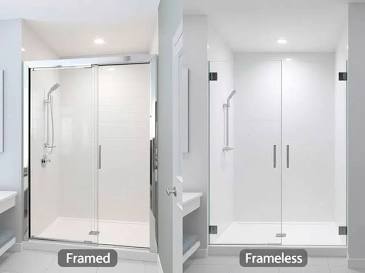
A frameless shower door is built from thick tempered glass — usually 3/8" to 1/2" — held in place with minimal hardware like hinges, clips, and brackets instead of a full metal frame. Frameless glass is heavier and uses high-quality hinges, clamps, and clips for proper installation, function, and style.
Pros of Frameless
- Open, airy feel. Without a bulky frame breaking up the sightline, your tile, fixtures, and lighting take center stage — which is especially useful in smaller Chicago bathrooms where every inch of visual space matters.
- Easier to clean. Fewer tracks, seals, and metal edges means less buildup of soap scum and water spots, and far less risk of mildew forming in hidden corners.
- More durable glass. Because the glass itself does the structural work, it's thicker and generally holds up better over the long haul.
- Higher perceived value. Frameless enclosures are often associated with updated, move-in-ready bathrooms, which can be a plus if you're planning to sell in the next few years.
Cons of Frameless
- Higher upfront cost, due to thicker glass, precision fabrication, and more labor-intensive installation.
- Requires accurate measurements. Because there's no frame to hide small gaps, the install needs to be precise — which is exactly why custom measuring matters.
- Slightly more water can escape the enclosure at the edges compared to a framed unit with full perimeter seals, though this is usually manageable with proper door placement and an occasional squeegee.
What Is a Framed Shower Door?
A framed shower door uses thinner glass panels — typically 3/16" to 1/4" — supported by a metal frame around the perimeter, usually in chrome, brushed nickel, matte black, or similar finishes.
Pros of Framed
- More budget-friendly. Thinner glass and simpler installation generally make framed doors the lower-cost option.
- Better at containing water. The frame, track, and caulk work together to keep water inside the shower, which can be helpful in bathrooms with limited floor drainage.
- Forgiving for older homes. If your walls or floors aren't perfectly level — common in older Chicago bungalows and greystones — a framed unit can accommodate small irregularities more easily than a frameless one.
- Wide range of finishes, so you can match existing fixtures and hardware throughout the bathroom.
Cons of Framed
- Maintenance over time. The metal frame and tracks can trap moisture, leading to soap scum, mildew, and eventually corrosion if not cleaned regularly.
- Can look dated next to newer tile work, vanities, or lighting if the rest of the bathroom has a more contemporary feel.
- More surfaces to clean — tracks, corners, and seals all need attention that a frameless door simply doesn't require.
Cost Differences: What to Expect
Pricing varies based on glass thickness, hardware finish, enclosure configuration (sliding, pivot, neo-angle, etc.), and the complexity of your space. As a general rule of thumb, framed shower doors tend to run lower than frameless units for a comparable size, mainly because of the glass thickness and labor difference. The exact gap depends heavily on your specific layout, so the most reliable way to compare costs is to get measurements taken and a quote built around your actual bathroom — not a generic online estimate.
If you want a deeper breakdown of what drives shower door and mirror pricing in the Chicago area, we cover that in more detail in our glass and mirror cost guide — and you're always welcome to request a free, no-obligation quote.
Which One Should You Choose?
Go frameless if:
- You're doing a full bathroom remodel and want a modern, cohesive look
- Your bathroom is on the smaller side and you want it to feel more open
- You're updating your home with resale in mind
- You're willing to invest a bit more upfront for easier long-term maintenance
Go framed (or semi-frameless) if:
- You're working with a tighter renovation budget
- Your bathroom has older, slightly uneven walls or flooring
- You want to match existing fixture finishes throughout the space
- You're upgrading from a shower curtain and want the most straightforward installation
For many homeowners, semi-frameless is a great middle ground — combining the open look of frameless glass with a bit more framing for stability and a lower price point than fully frameless. We're happy to walk through all three options on-site and show you samples of each.
Beyond the Shower: A Cohesive Glass Look
Shower doors are often just one part of a larger bathroom or home update. If you're already investing in new glass, it's worth thinking about the bigger picture:
- Mirrors — Custom-cut bathroom mirrors in matching finishes can tie your new shower enclosure into the rest of the room.
- Glass walls and partitions — If you're opening up your bathroom layout or adding a glass divider between the shower and vanity area, our glass walls and panels services use the same tempered glass and hardware quality as our shower doors.
- Commercial spaces — For business owners, we also handle commercial glass work, including storefront glass for offices and retail spaces throughout Chicago and the suburbs.