Shower Door vs Open Walk-In Shower: Pros and Cons
By Abdullah Ghabayen, Glass and Shower Doors | 25 years of glass fabrication and installation across Chicago and the western suburbs | Published September 21, 2026
Quick Answer
An open walk-in shower uses a fixed glass panel, or no glass at all, and has no door to open or close. It looks clean, is easy to step into, and has fewer parts to maintain. But it needs more floor space, lets more water and cold air out, and cannot hold steam. A shower with a door keeps water and heat inside, fits smaller bathrooms, and works with any layout. For large bathrooms with a long shower, an open walk-in with a fixed panel works well. For small or average bathrooms, a door is usually the better choice.
Doorless walk-in showers are everywhere in design photos right now. They look open, calm, and modern.
But photos do not show the puddle on the floor, the chill when you step out, or the extra square footage the layout needs. Before you skip the door, you need to know what you gain and what you give up.
This guide compares a shower with a glass door to an open walk-in shower, point by point, so you can choose the layout that works in your bathroom, not just in a magazine.
What Is an Open Walk-In Shower?
An open walk-in shower has an entry with no door. You walk in around the end of a glass panel or a short wall.
There are two main types:
- Fixed glass panel (sometimes called a shower screen). One or two panels of tempered glass block the spray. The entry stays open.
- Fully doorless. No glass at all. The shower is set deep in the room or behind a tile wall so water stays inside.
Many open walk-ins are also curbless, meaning the shower floor is level with the bathroom floor. Others keep a low curb.
What Is a Shower With a Door?
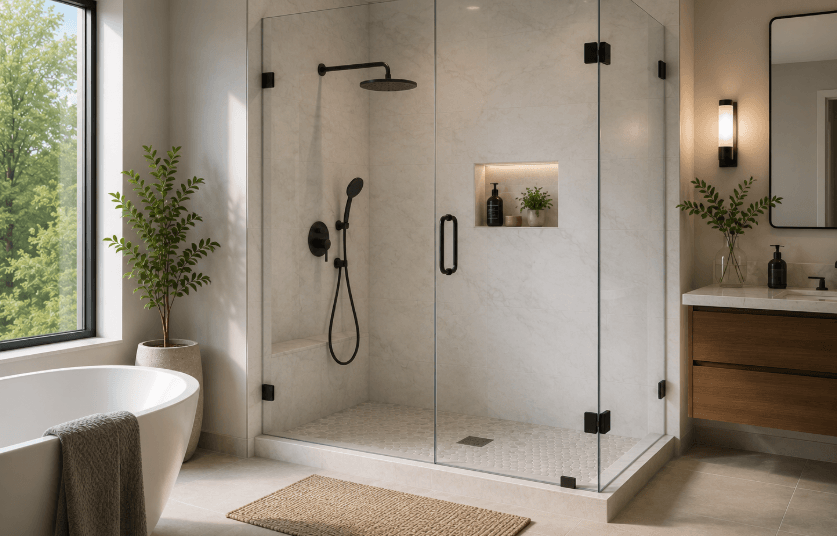
A shower with a door is fully enclosed. You open a hinged or sliding glass door to step in, then close it behind you.
Common door styles:
- Frameless shower doors: thick glass with minimal hardware
- Semi-frameless shower doors: partial framing for extra support
- Sliding shower doors: no swing space needed
Not sure which door style fits? Read our Frameless vs Framed Shower Doors: Full Comparison.
Shower Door vs Open Walk-In Shower: Side-by-Side
| Feature | Shower With a Door | Open Walk-In Shower |
|---|---|---|
| Look | Clean with frameless glass | Very open and minimal |
| Space needed | Works in small bathrooms | Needs a longer shower area |
| Water control | Best | Depends on size and layout |
| Warmth | Holds heat | Can feel cold and drafty |
| Steam shower | Yes | No |
| Moving parts | Hinges, seals, sweep | None with a fixed panel |
| Cleaning | Glass, seals, sweep | Less glass, but more wet floor |
| Easy entry | Good | Best |
| Glass cost | Higher | Lower with a single fixed panel |
| Construction needs | Standard | Often needs more floor and drain planning |
| Best for | Most bathrooms | Large bathrooms and long showers |
1. Space: The Biggest Deciding Factor
This is where most open shower plans succeed or fail.
A shower door blocks the spray, so the shower can be compact. The minimum shower size allowed by the model plumbing code is small, and a door works fine even in a tight space.
An open walk-in has no door to stop water. So it relies on distance. The water has to hit the floor and drain before it reaches the opening.
Rule of thumb: An open walk-in works best when the shower is long, often around 5 feet or more, with the showerhead at the far end away from the entry. A short or square shower with an open entry usually lets water out onto the bathroom floor.
If your shower is small or square, a door is almost always the better option.
2. Water Control and Splash
With a door: Water stays inside. A frameless door with good seals and a bottom sweep keeps the bathroom floor dry. Framed doors seal even tighter.
Open walk-in: Some water will reach the entry. How much depends on:
- How long the shower is
- Where the showerhead and handheld point
- The height and width of the glass panel
- Whether you use a rain head, which falls straight down, or a wall head, which sprays outward
- How well the floor slopes to the drain
Rain heads and ceiling-mounted heads work better in open showers. A high-pressure wall head aimed at the opening will soak the floor.
Watch out for kids. Children tend to splash and spray in every direction. An open shower in a kids’ bathroom often means a wet floor.
Already fighting water on the floor? See Shower Door Leaking? Causes, Fixes, and How to Stop It.
3. Warmth and Comfort
This matters in Chicago.
A shower with a door traps warm, moist air. The space heats up quickly and stays warm while you shower.
An open walk-in lets warm air escape and cooler room air flow in. Many people notice a chill, especially on cold winter mornings. The effect is stronger in large bathrooms, bathrooms with high ceilings, and homes with drafty windows.
Ways to warm up an open shower:
- Heated floors
- A glass panel that runs close to the ceiling
- A smaller entry opening
- A warmer room temperature in winter
If you run cold or love long hot showers, a door is the more comfortable choice.
4. Steam Showers
A steam shower needs a fully sealed enclosure: floor-to-ceiling glass, a door, and a transom panel at the top. Open walk-ins cannot hold steam.
If you want steam now or later, plan on a door.
5. Cleaning and Maintenance
This one cuts both ways.
Open walk-in advantages:
- No door hinges to adjust
- No seals or sweeps to replace
- Less glass to squeegee with a single panel
- No handle or door edges to clean around
Open walk-in drawbacks:
- The bathroom floor near the entry gets wet more often
- Water on the bathroom floor can reach grout, baseboards, and vanity bases
- Moisture spreads into the room, so ventilation becomes more important
Door advantages:
- Water and moisture stay inside the shower
- The rest of the bathroom stays drier
Door drawbacks:
- More glass to clean
- Seals and sweeps wear out every few years
- Hinges may need an occasional adjustment
Chicago hard water tip: Squeegee all glass after every shower, whether you have a door or a panel. Hard water spots form fast here.
6. Moisture and Mold in the Bathroom
A shower door keeps steam and water contained. An open shower lets more moisture into the room.
With an open walk-in, a strong exhaust fan is important. Run it during the shower and for a while after. Without good ventilation, you may see more condensation on mirrors, walls, and windows, and more risk of mildew outside the shower.
7. Accessibility and Aging in Place
Open walk-ins win here.
A curbless open shower is one of the best layouts for aging in place. There is no door to open, no curb to step over, and plenty of room for a shower chair or walker.
A shower with a door can also be accessible. Wide doors, low curbs, and fixed panels paired with a swing door all help. But an open, curbless entry is the easiest to use.
If long-term accessibility is a goal, read Accessible Shower Glass Options for Aging in Place in Chicago.
8. Cost
The glass cost and the construction cost are two different things.
Glass cost:
- A single fixed glass panel usually costs less than a full enclosure with a door, because there are fewer panels and less hardware.
- A shower door adds hinges, a handle, seals, a sweep, and more precise fitting.
Our custom frameless shower doors start at $999. For details, see How Much Do Custom Shower Doors Cost in Chicago?
Construction cost:
An open walk-in can cost more overall if it requires:
- A larger shower footprint
- A curbless floor, which often means lowering the subfloor
- A linear drain
- Waterproofing that extends past the shower area
- Heated floors to offset the chill
So a doorless shower may save on glass but cost more in tile, plumbing, and floor work. Get both numbers before you decide.
9. Construction Needs for Curbless Open Showers
Curbless showers are popular with open layouts. They also take the most planning.
What a curbless shower usually needs:
- A recessed floor. The shower area is lowered so the floor can slope to the drain without a curb.
- Proper slope. The floor must slope toward the drain so water does not run into the room.
- A linear or well-placed drain. Linear drains along the back wall or entry are common.
- Wider waterproofing. Many installers extend waterproofing beyond the shower area.
Plan this early. These choices happen during framing and plumbing, long before glass. Talk to your contractor and your glass company at the start. Our shower door installation timeline explains when glass fits into a remodel.
10. Safety
Glass: Any glass in a shower area must be safety glass, which in practice means tempered glass. That applies to fixed panels and doors alike. Learn more in Is Tempered Glass Required by Code for Shower Doors?
Door swing: Hinged shower doors must be able to swing out of the shower. This matters in an emergency. It also means you need clear floor space in front of the door.
Slipping: Open showers can leave the bathroom floor wet near the entry. Choose slip-resistant tile and keep a mat just outside the wet zone.
Wall support for fixed panels: A large fixed glass panel is heavy. It needs solid anchoring and often a support bar to the wall or ceiling to keep it rigid.
11. Look and Design
Open walk-in: Very clean and calm. No handle, no door edges, no hinges. A single glass panel almost disappears. It works well with large-format tile, stone slabs, and spa-style bathrooms.
Shower with a door: A frameless door also looks clean and modern. Hardware can match your faucet and fixtures in chrome, brushed nickel, matte black, or brass. See our Shower Door Hardware and Finish Guide.
Both styles fit today’s bathroom trends. Read more in 2026 Bathroom Remodel Trends: Why Frameless Glass Is Dominating Design.
12. Resale Value
Buyers like both layouts when they are done well.
An open walk-in in a large primary suite reads as high-end and spa-like. But a cramped open shower that splashes water across the floor can turn buyers off.
Many buyers, especially families with young kids, still prefer a shower with a door. If your home has only one full bathroom, a door or a bathtub may appeal to more buyers.
Pros and Cons at a Glance
Shower With a Door
Pros:
- Best water control
- Holds heat and feels warmer
- Works in small and average bathrooms
- Works with steam showers
- Keeps moisture out of the rest of the room
- Works with any showerhead layout
Cons:
- More glass to clean
- Hinges, seals, and sweeps need upkeep
- Hinged doors need swing space
- Higher glass cost
Open Walk-In Shower
Pros:
- Very open, minimal look
- Easiest entry, great for aging in place
- No hinges, seals, or sweeps to maintain
- Lower glass cost with a single panel
- Pairs well with curbless floors
Cons:
- Needs a longer shower area
- More splash onto the bathroom floor
- Can feel cold and drafty
- Cannot work as a steam shower
- More moisture in the room
- Curbless versions add construction cost
Which One Should You Choose?
Choose an open walk-in shower if:
- Your bathroom is large and the shower is long
- You want the easiest entry for aging in place
- You prefer a rain head or ceiling head
- You want fewer moving parts
- You are building a curbless shower in a full remodel
Choose a shower with a door if:
- Your bathroom is small or average size
- Your shower is square or short
- You want the warmest shower in winter
- You want a steam shower now or later
- Kids use the bathroom
- You want the floor to stay dry
Consider a hybrid: A fixed panel plus a hinged door gives you an open, clean look with full water control. It is one of the most popular layouts we install. Another option is a fixed panel with a small hinged return panel that helps block the spray at the entry.
Mistakes to Avoid
Putting an open entry near the showerhead. Water will head straight for the floor. Keep the entry at the far end.
Using a panel that is too short. A short panel saves money but lets more water out. Match the panel length to the shower.
Skipping the exhaust fan. Open showers put more moisture into the room.
Choosing an open shower for a small bathroom because it looks bigger in photos. In a small room, a frameless door often looks just as open and keeps the floor dry.
Deciding on glass after the tile is done. Open shower layouts need planning at the framing stage. Blocking for heavy glass and floor slope must be set before walls and floors close.
Frequently Asked Questions
Do walk-in showers without doors get water everywhere?
Not if they are designed well. An open walk-in needs enough length for water to drain before it reaches the entry, a showerhead placed away from the opening, and a floor that slopes to the drain. In a short or square shower, water often escapes onto the bathroom floor.
How big does a doorless walk-in shower need to be?
There is no single rule, but open walk-ins work best when the shower is long, often around 5 feet or more, with the showerhead at the far end from the entry. Small or square showers usually need a door to keep water inside.
Are open walk-in showers cold?
They can be. Without a door, warm air escapes and cooler room air flows in. Many Chicago homeowners notice this in winter. Heated floors, a taller glass panel, and a smaller entry can help.
Is a walk-in shower cheaper than a shower door?
A single fixed glass panel usually costs less than a full enclosure with a door. But an open walk-in can cost more overall if it needs a larger shower, a curbless floor, a linear drain, or extra waterproofing.
Can you have a steam shower without a door?
No. A steam shower needs a fully sealed enclosure with a door and a glass transom panel at the top to hold the steam inside.
Are doorless showers good for seniors?
Yes. A curbless open shower is one of the best layouts for aging in place. There is no door to open and no curb to step over, and there is room for a shower chair or walker.
Can I add a door to my walk-in shower later?
Often yes. If the fixed panel and wall support allow it, a hinged door or return panel can sometimes be added. In other cases, the panel needs to be replaced. We can check your layout during a free measurement.
Not Sure Which Layout Fits Your Bathroom?
We measure, fabricate, and install fixed glass panels, frameless doors, and full enclosures across Chicago and the suburbs. At the measurement, we look at your shower size, showerhead location, floor slope, and wall support, then recommend the layout that will actually keep your floor dry.
Call (708) 808-7775 or get a free quote. Learn more about our custom shower doors and glass walls and panels.